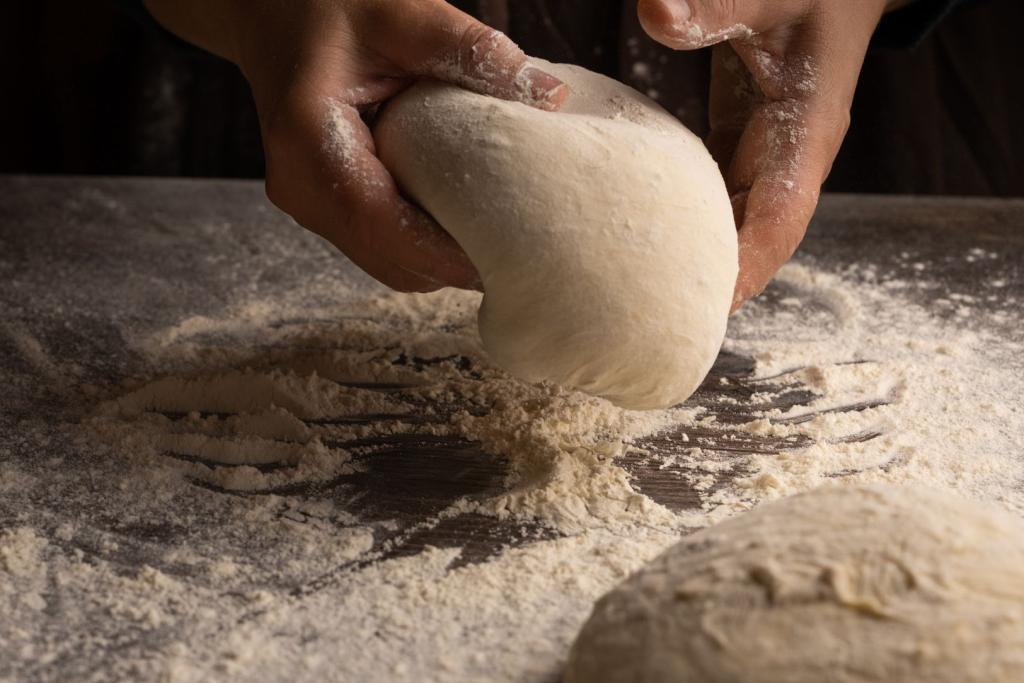
Bread dough proofing can feel like a timer-based guessing game, especially when a recipe says to wait until the dough doubles and your kitchen is cooler, warmer, or simply different. The more reliable approach is to separate three jobs: kneading builds and organizes structure, resting gives flour and dough time to relax, and proofing describes fermentation-driven expansion. These processes overlap, but they are not interchangeable—and no single rise time fits every kitchen.
What kneading develops in wheat dough
Wheat flour contains the proteins glutenin and gliadin. When flour meets water, these proteins hydrate and begin forming gluten; kneading adds movement and mechanical energy that help link and organize the proteins into a stronger, continuous network. According to King Arthur Baking’s guide to gluten, glutenin contributes elasticity while gliadin contributes extensibility—the dough’s ability to stretch. A useful bread dough needs enough of both qualities to expand without tearing easily.
That network gives dough its springy, stretchy character and helps it hold gas bubbles as it rises. A 2022 wheat-dough study published in Polymers describes hydration and mechanical energy during kneading as part of gluten-network development, and notes that small gas nuclei introduced during kneading can seed the crumb’s bubbles later. Its laboratory kneading conditions are not a home recipe, but the underlying point travels: kneading is structure-building, not simply a way to make a dough ball look tidy.
For a home baker, look for the dough to become more cohesive, smoother, and elastic as the recipe’s mixing method develops it. A small piece may stretch thinner before tearing than it did at the start, although enriched doughs, whole-wheat flour, hydration, and mixing style can change what that looks like. Do not assume every dough needs the same number of minutes or a dramatic windowpane test; recipes for no-knead bread rely on time, hydration, and folds instead of prolonged hand kneading.
Resting is not the same as proofing
A rest is a pause in handling. After mixing or kneading, time lets flour finish absorbing water and lets a tight, worked dough relax, so it may feel less resistant when you stretch or shape it. This is especially useful when dough keeps snapping back during rolling or shaping. Resting does not mean the dough’s yeast is switched off: if the dough contains yeast or an active sourdough culture, fermentation can continue during the rest.
Proofing, by contrast, is about fermentation and the dough’s rise. Bakers often use “proof” loosely for any rise, but the more technical distinction is that the first rise is commonly called bulk fermentation, while the final rise after shaping is the final proof. According to King Arthur Baking’s proofing guide, proofing is the dough’s fermenting rise; in a typical loaf, bulk fermentation comes before shaping, and the shaped dough then proofs again before baking. A recipe may include a short bench rest between stages, but that rest is not automatically the same thing as a full proof.
In practical terms, kneading changes the dough’s structure through work; resting changes how hydrated and relaxed it feels; proofing lets yeast fermentation inflate that structure. If a recipe says to rest the dough for 15 minutes, treat that as a handling instruction rather than a universal signal that the dough has doubled. If it says to proof until ready, watch the dough as well as the clock.
What yeast fermentation adds
Yeast uses available sugars in the dough and releases carbon dioxide. The stretchy gluten network retains some of that gas, so the dough expands and its internal bubbles grow. Kansas State University Extension’s homemade-bread guidance explains that yeast fermentation produces carbon dioxide, which becomes trapped in elastic dough and makes it rise. Fermentation also generates flavor compounds; the aroma and taste of a slowly developed dough can differ from a quickly risen one.
Yeast does not simply pump air into dough, and more rise is not always better. Gas production, the strength of the gluten network, and the time the dough has had to ferment all matter together. If dough is baked too early, it may not have expanded enough; if it goes too far, its structure may no longer hold its shape well. Flour type, hydration, enrichment, yeast quantity, dough temperature, room temperature, and whether the dough is covered or chilled can all shift the pace, which is why recipe times are best treated as estimates.
Visual cues: underproofed, ready, or overproofed?
During bulk fermentation, note the dough’s starting level in a straight-sided container or mark the bowl with tape. Look for visible expansion, a smoother or airier surface, and bubbles along the sides or top, while following the recipe’s own target rather than assuming every dough should exactly double. A cool room may slow the rise; a warm room may speed it up. The same dough can also move at a different rate on another day. That is why bread dough proofing is best judged as a changing process, not a countdown.
For a shaped free-form loaf at final proof, a gentle poke can help when used alongside the recipe’s other signs. If a lightly floured fingertip leaves an indentation that springs back immediately, the dough may need more time; if it returns slowly and only partway, it is often close to ready. If the dent stays pronounced and the dough feels very fragile, slack, or begins to sink, it may be overproofed. King Arthur’s guide describes the poke test as one cue, while its over-proofing article shows how an excessively risen pan loaf can lose capacity for a strong oven spring and collapse.
Use those signs as a comparison, not a pass-fail law: high-hydration dough, enriched dough, whole-grain dough, and different shaping styles can feel and respond differently. A pan loaf has a practical visual landmark—its height relative to the rim—while a free-form loaf depends more on shape retention and the poke response. A dent alone cannot tell the whole story, and during bulk fermentation, volume and visible activity are usually more useful than poking.
A practical way to read your dough
To make the next bake less mysterious, note the room or dough temperature if you know it, the time when mixing ended, and how long the dough took to reach the recipe’s visual target. Compare the same recipe in your usual kitchen rather than borrowing a timing rule from someone else’s oven or climate. If the dough is still tight and barely expanded, give it more time and check again; if it has become airy and delicate, handle it gently and avoid extending the rise just because a printed time has not elapsed.
The short version: kneading strengthens the wheat dough’s gluten network; resting lets it hydrate and relax; proofing is fermentation-driven rise, though fermentation may continue during a rest. Yeast supplies carbon dioxide and contributes flavor, while dough strength determines how well the expanding bubbles are retained. Read the dough’s volume, surface, feel, and response to a gentle poke in context, and let the recipe’s timing guide—not overrule—what you can see.
Comments 0
No comments yet. Be the first to share your thoughts!
Leave a comment
Share your thoughts. Your email will not be published.