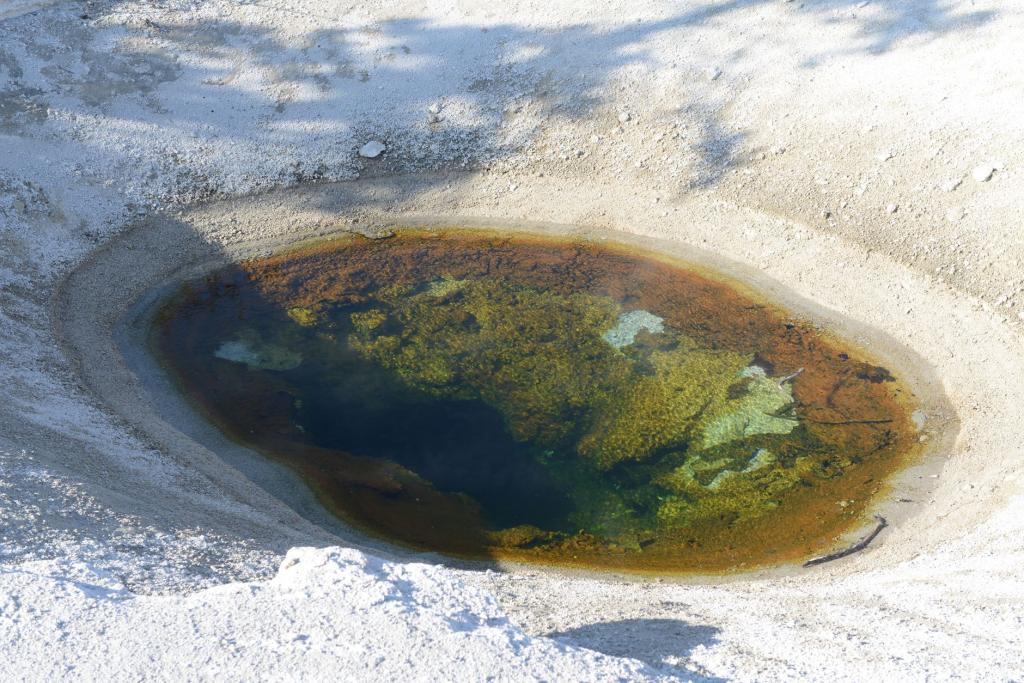
An amoeba found in the heated waters of California's Lassen Volcanic National Park can reproduce at 145 degrees Fahrenheit (63 degrees Celsius), the highest temperature ever recorded for an organism with complex cells. The finding was published Tuesday in the journal Cell, breaking a record of 140 degrees Fahrenheit (60 degrees Celsius) previously held by a few species of fungi and red algae.
The fire amoeba, formally named Incendiamoeba cascadensis, stops reproducing just above that ceiling but keeps moving and feeding at temperatures up to 147 degrees Fahrenheit (64 degrees Celsius), NASA reported in a summary of the research. NASA-supported scientists led the study.
High heat tears apart the proteins and membranes that complex life needs to function. Eukaryotes, the broad group of organisms whose cells carry a nucleus holding genetic material, also contain structures such as mitochondria and endoplasmic reticulum that carry out specific jobs inside the cell. Researchers had suggested the membranes of those structures could not stay stable above 144 degrees Fahrenheit (62 degrees Celsius). The fire amoeba shows that view was wrong.
How the fire amoeba survives the heat
Study lead Beryl Rappaport, a graduate student at Syracuse University, and colleagues sequenced the amoeba's genome and tracked how its genes behave at different temperatures. They found many genes that help the fire amoeba stabilize its DNA and keep it from breaking down, along with genes that let the organism sense conditions outside its cell. As the temperature climbed, certain genes grew more active, including genes that maintain proper protein folding.
Some of the fire amoeba's proteins carry a high positive surface charge that helps them stay stable. Those charges resemble proteins found in heat-loving bacteria and archaea, the team reported. Rappaport said the researchers uncovered many strategies that may help I. cascadensis survive extreme heat, and that "some of these strategies could be used by thermophiles across all life."
Rappaport said studies of eukaryotes "may have been limited because of assumptions about membrane stability," and hopes the discovery encourages other scientists to keep hunting for eukaryotes in hot environments. To count as a true thermophile, an organism must replicate, move, eat, and survive above 113 degrees Fahrenheit (45 degrees Celsius), according to NASA.
Relatives may be hiding in hot springs worldwide
The researchers also compared genetic data from geothermal studies conducted around the world. In that data they found similar pieces of DNA in samples from New Zealand and Yellowstone National Park, which suggests that other fire-amoeba relatives related to I. cascadensis may be living across the globe, waiting to be discovered.
Astrobiologists study organisms at the edges of habitability to understand where life might exist on worlds less hospitable than Earth. Such extremophiles also produce unique proteins with possible uses in industry and medicine. Until now, most extremophile research has focused on bacteria and archaea, the simpler single-celled prokaryotes that have no nucleus. Prokaryotes have less cellular machinery that heat can damage, and scientists believe they were the first forms of life to appear on Earth, billions of years ago, when the planet was far more hostile than it is today.
Olcott said studying extremophiles helps scientists understand the biochemical and physiological limits of life on Earth, and that the information "helps guide NASA's search for life" by expanding "the range of conditions we think life could potentially be inhabiting elsewhere." Alison Olcott is the program scientist for Exobiology at NASA Headquarters in Washington, which funded the research.
More science on GenZNewZ: read the McGill study finding exercise protects memory after sleep loss and the ancient peace treaty fragment identified at the Hittite capital Hattusa.
Olcott said the discovery expands understanding of both "where life could be found" and "how complex that life could be." Temperature is only part of the picture, the researchers cautioned. Rappaport noted that "it could certainly be possible" for complex life like the fire amoeba to exist on another planet, but said Earth is the only planet known to meet all of its requirements, including "the right acidity, oxygen levels, pressure, water, and food." The fire amoeba could not survive alone, the researchers said, because it needs other life in its environment to sustain it. NASA's full summary of the research is published at science.nasa.gov.
Comments 0
No comments yet. Be the first to share your thoughts!
Leave a comment
Share your thoughts. Your email will not be published.