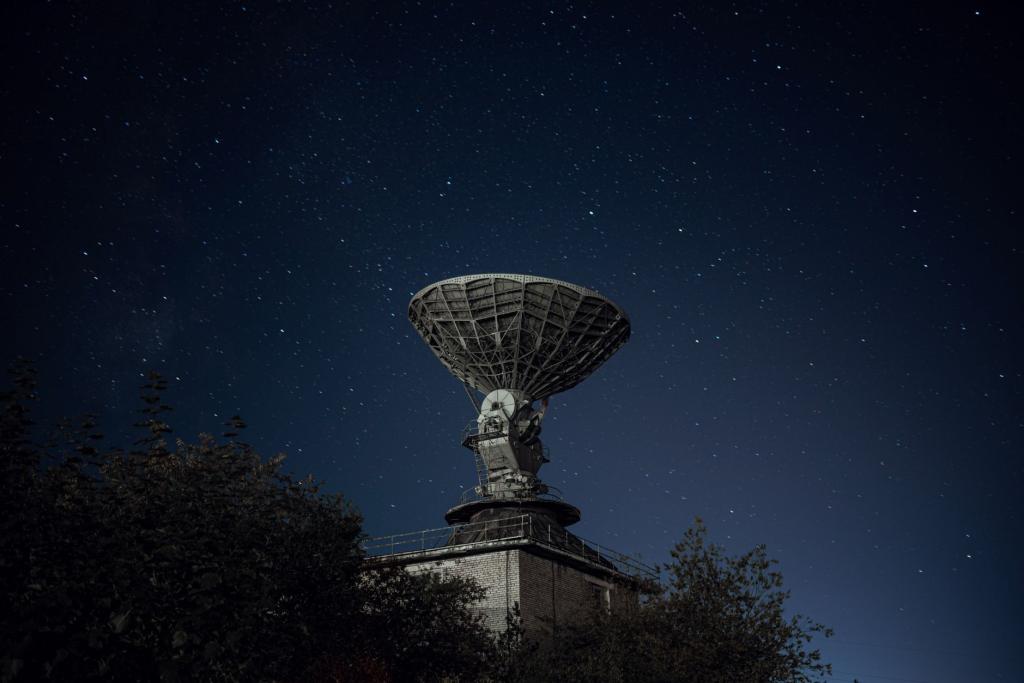
For more than three decades, astronomers have measured the masses, orbits, and atmospheric chemistry of planets around other stars. But one basic property of alien worlds has stayed stubbornly out of reach: the magnetic field. This month, researchers reported the first direct measurement of one, on a gas giant 64 light-years away, and the signal they caught was an exoplanet aurora.
The detection was made with the MeerKAT radio telescope, an array of 64 dishes in South Africa's Karoo desert. On four observing runs between February 2025 and May 2026, the team picked up rapid, repeating bursts of radio waves from the Beta Pictoris system, along with a fainter, steady radio glow between bursts. The waves were strongly circularly polarized, a signature that matches radiation produced by auroral activity. They reported the result in a paper posted to the arXiv preprint server on September 15, written by Kevin Ortiz Ceballos and Edo Berger of the Center for Astrophysics at Harvard and the Smithsonian, and Yvette Cendes of the University of Oregon.
The team is explicit about what the signal is not: alien technology. Radio waves are emitted by plenty of natural processes, and the researchers identify this one as auroral emission, the same family of physics behind the northern lights on Earth and the powerful radio storms of Jupiter. What makes it a milestone is that earlier searches either came up empty or could not prove the waves came from a planet rather than its star. This is the first time an exoplanet aurora has been pinned to a specific world.
What an exoplanet aurora looks like up close
The physics of an exoplanet aurora works like this. Electrons spiraling along magnetic field lines near a planet's poles emit coherent radio waves, through a process called the electron cyclotron maser instability. The top frequency of that emission reveals the field strength at its source. The bursts from Beta Pictoris b reached 3.5 gigahertz, which implies a magnetic field of at least 1.25 kilogauss where the radiation originates, more than two thousand times the strength of the magnetic field measured at Earth's surface.
Beta Pictoris b was a natural target. It is a young, massive gas giant, roughly twelve times the mass of Jupiter, orbiting its star at about ten times the Earth-Sun distance once every 24 years. The whole system is only about 23 million years old. Young giants spin fast and run hot interiors, which is exactly the recipe theory predicts for a powerful magnetic dynamo. As the paper notes, the measured field sits right where dynamo scaling models said it should.
Why hunting an exoplanet aurora took decades
Magnetic fields are among the most consequential things you cannot see. The paper opens with the case for them: they shape how atmospheres escape into space, how stellar winds batter a planet, and what is churning in its interior. Earth's field deflects the solar wind and funnels particles toward the poles, where they strike the upper atmosphere and glow. Mars, which lost its global field billions of years ago, also lost much of its atmosphere to the solar wind. A strong magnetic field is one ingredient in keeping a planet, and perhaps a habitable one, intact. The problem is that no one had ever measured an exoplanet aurora and used it to weigh a field directly until now.
The hunt has run for decades. Previous radio searches of directly imaged exoplanets produced only upper limits, including earlier observations of Beta Pictoris b itself at lower frequencies. In other systems where coherent radio emission turned up, astronomers could not rule out the host star as the source. A claimed detection around the star Tau Bootis in 2020 collapsed for exactly that reason. The difference this time is not just a brighter signal, but proof of where it came from.
Proving an exoplanet aurora came from the planet, not the star
Stars are magnetically active too, so localization was the whole battle. The team anchored its radio images to the Gaia celestial reference frame using nine distant quasars detected in the same field, plus one calibration source, and solved for the frame correction. They then propagated the known positions of the star and its planets to the exact dates of observation. After correction, the radio source landed on the position of Beta Pictoris b and missed the star by 4.4 standard deviations. It missed the smaller planet c by 4.8. Monte Carlo tests covering ionospheric distortion and fitting errors kept the result intact.
The team also checked what could drive an exoplanet aurora this bright. A stellar wind blowing against the planet's magnetosphere under-predicts the observed power by three orders of magnitude. An interaction with a moon, in the style of Jupiter and Io, is energetically too weak, and existing observations independently rule out any moon as massive as Saturn around this planet. What fits is coupling between the planet's magnetosphere and ionosphere, driven by its own rapid spin. Spectroscopy gives Beta Pictoris b a day of eight to nine hours, and two of the bursts arrived about eight hours apart, consistent with a beacon sweeping past as the planet turns. Like Jupiter, a fast-spinning magnetosphere loaded with plasma develops shear that drives electric currents into the atmosphere and lights the aurora. Recording an exoplanet aurora powered this way turns a theory about giant planets into an observed fact.
What the first exoplanet aurora unlocks
The method should travel. The paper names seven more directly imaged giant planets in five other star systems within 45 parsecs where the same astrometric technique applies, and notes that next-generation radio observatories are expected to be five to seven times more sensitive than today's, which would bring those targets within reach. Long-term monitoring of Beta Pictoris b could go further, revealing the tilt of its magnetic axis and the shape of its magnetosphere as the signal repeats with the planet's rotation.
For habitability science, the payoff is indirect but real. If the technique can be extended to rocky planets, astronomers would gain a way to test which worlds still carry magnetic shields and which lost them long ago. The paper adds one more curiosity: faint X-ray emission once attributed to the star may actually be coming from the planet, which would place it on a radio-X-ray relationship seen in similar aurora-producing objects.
One caution is in order. The paper is a preprint and has not yet completed peer review. Independent reaction has been positive: Oxford astrophysicist Suzanne Aigrain said earlier detections were tentative and indirect, and described this one as the first truly convincing direct detection of radio emission from an exoplanet, according to coverage of the paper. If the result survives scrutiny, astronomers have a new sense for studying other worlds: not only seeing them, but listening to their magnetic fields. The first exoplanet aurora on record is unlikely to be the last.
Comments 0
No comments yet. Be the first to share your thoughts!
Leave a comment
Share your thoughts. Your email will not be published.