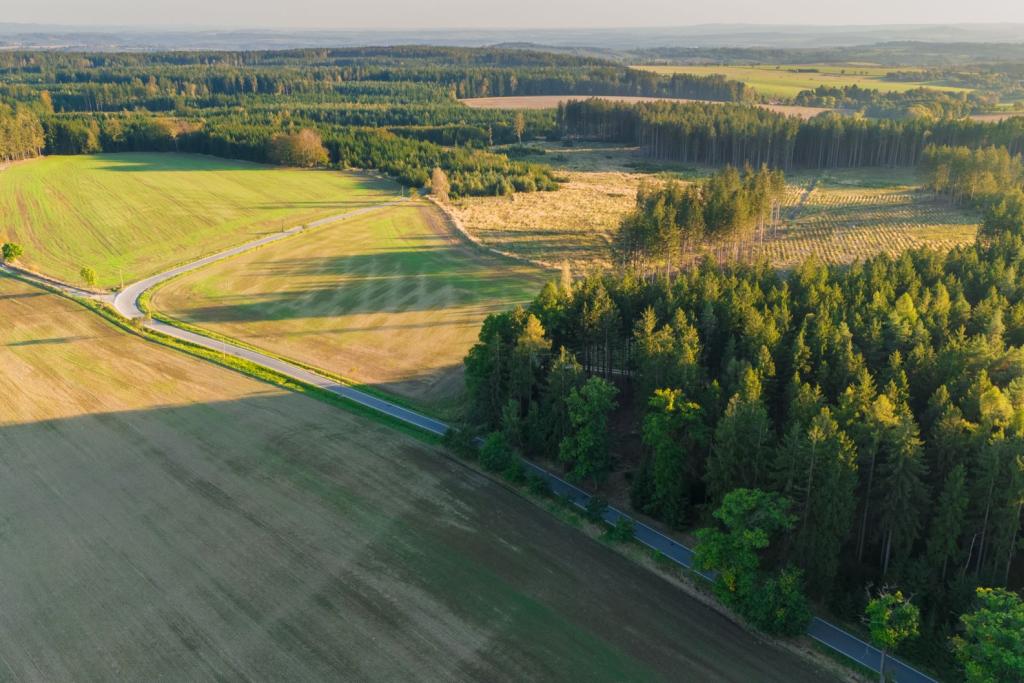
The European Space Agency put a new kind of Earth watcher into orbit on 15 September, when a Vega-C rocket lifted off from its pad in French Guiana carrying the Fluorescence Explorer, or FLEX, alongside the Copernicus Sentinel-3C satellite. Flight VV30 left Europe's Spaceport in Kourou at 03:21 Central European Summer Time on a moonlit Monday morning, and controllers at ESA's operations centre in Darmstadt picked up the first signals from both spacecraft within hours of separation. The FLEX satellite launch opens the first space mission built specifically to measure the faint glow that plants give off as they photosynthesize.
The rocket's upper stage released Sentinel-3C first, roughly an hour into the flight, and FLEX followed about an hour later after a smaller adapter separated the two payloads stacked inside the fairing. Both spacecraft called home quickly, prompting the agency to confirm online that the pair were in orbit and healthy. The launch was only the eighth flight of the Vega-C and the second managed entirely by Italian manufacturer Avio without its former partner Arianespace. A brief commissioning phase now follows, during which engineers check every instrument before routine science work begins.
A satellite built to read the glow of plants
FLEX is the eighth mission in ESA's Earth Explorer series, and its job is unlike anything flown before. Every green leaf absorbs sunlight and puts most of it to work making food, but a tiny leftover fraction escapes as fluorescence, a very faint light that is invisible to the human eye. That glow sits close to the much stronger sunlight bouncing off the same leaves, which made it nearly impossible to detect from space until recently.
The spacecraft carries the Fluorescence Imaging Spectrometer, known as FLORIS, which stares at wavelengths between 500 and 780 nanometres. It pays special attention to the bands where oxygen in the atmosphere absorbs light, because those dips let scientists tease the weak plant signal apart from reflected sunlight. According to the agency, the instrument will map how actively vegetation is photosynthesizing and how that activity shifts with the carbon and water cycles, as reported by Spaceflight Now.
The real prize is early warning. A struggling plant slows its internal machinery before its leaves yellow or brown, so reading fluorescence can flag stress days or weeks before cameras on other satellites notice a change. That matters for farmers, foresters and climate researchers alike. The launch arrives after a summer of severe heat, low rainfall and widespread drought across parts of Europe, when water stress left vegetation parched and cut the carbon dioxide crops pulled from the air, as described in a Muser Press report drawing on University of Zurich research.
Scientists at the University of Zurich, who helped develop the mission over nearly two decades, expect the data to reveal how forests absorb carbon, how drought damage builds at an early stage and even how algae behave in lakes, since fluorescence techniques also work over water. FLEX will sweep the globe about once a month at a resolution near 300 metres, building a repeating portrait of plant health that no existing fleet can match. After roughly three and a half years of operations, researchers expect to know whether long-term monitoring of photosynthesis from orbit deserves a permanent programme.
Two satellites, one climate mission
FLEX did not ride alone. Its cabin mate was Sentinel-3C, the third satellite in the European Union's Copernicus Sentinel-3 series, which watches oceans, land, ice and atmosphere around the clock. The 1,143-kilogram craft carries instruments that measure sea and land surface temperature, ocean colour, sea-surface height and cloud properties, and it doubles as a near-real-time wildfire tracker. Its operators at EUMETSAT say the new satellite will take over from the ageing Sentinel-3A, which has already outlived its planned 7.5-year lifetime, keeping Europe's environmental data records unbroken into the 2030s.
The pairing was deliberate. FLEX will fly in tandem with Sentinel-3C, trailing about one kilometre behind and crossing the same ground a few seconds later, so the two data streams describe the same scene. One reports the health of the vegetation; the other supplies the atmospheric context around it, from temperature and aerosols to cloud cover. Mission chiefs say that combination turns two separate observations into a fuller story about how crops and forests react to a changing climate. For readers tracking how orbit keeps watch on the planet, GenZ Newz's archive follows the missions turning space hardware into climate data.
The tandem revisit works out to a global sweep roughly every 27 days for FLEX, while Sentinel-3C's broader instruments scan far more often. Together they feed models used for ocean forecasting, disaster response and agriculture, and a later Sentinel-3D is already pencilled in for 2029 to replace the second ageing satellite in the series. The European Commission says six more Copernicus expansion missions are in development for launch from 2027 onward, including dedicated carbon dioxide monitors.
For now, the immediate work is commissioning: testing solar panels, cooling the spectrometer and calibrating its sensors against ground stations. FLEX carries only about 30 kilograms of propellant and must save roughly half for a controlled deorbit at the end of its life, so mission managers will husband every drop to stretch the science campaign as long as possible. Earth Explorer missions have a habit of outliving their warranties, and if FLEX follows the pattern, its quiet map of plant glow could become a fixture of climate science for years to come.
Comments 0
No comments yet. Be the first to share your thoughts!
Leave a comment
Share your thoughts. Your email will not be published.