Botanists in China have formally described a fern that spent nearly two centuries filed under the wrong name. The plant, Drynaria lineatisora, was collected in Myanmar and Vietnam as early as the 1800s and repeatedly logged as Drynaria coronans, a widespread relative. Fresh fieldwork and DNA analysis have now shown it is a species in its own right, according to the paper published in Phytotaxa.
The work was led by researchers at the Xishuangbanna Tropical Botanical Garden of the Chinese Academy of Sciences, working with collaborators. They combined close study of the plant's shape with scanning electron microscopy of its spores and scales and an analysis of its DNA, to test whether Drynaria lineatisora was truly distinct. The paper, led by Li-Ju Jiang, drew on specimens gathered in the field as well as material held in herbaria, some of it collected in the 1800s and filed away as Drynaria coronans ever since.
That long misfiling is the heart of the story. Botanists had the plant in hand for generations, in collections from Myanmar and Vietnam, without recognizing it as something new. It took fresh surveys in the mountains where it grows, plus a close look at features too small to see with the naked eye, to separate Drynaria lineatisora from its better-known relative. A report on the discovery describes how the team worked through those details.
The clues were on the underside of the fronds
The clearest difference sits on the underside of the fronds. Drynaria lineatisora carries elongated, linear sori, the clusters that produce spores, in unbroken lines that can reach 20 millimeters long. Drynaria coronans, by contrast, bears circular or short linear sori that sometimes merge as the plant matures, which blurred the line between the two.
The scales tell a similar story. Drynaria lineatisora has dark brown, lance-shaped scales with finely toothed edges, while its relative has pale yellow, long and narrow scales with fringed edges. Under the electron microscope, the spores of Drynaria lineatisora turned out to be covered in fine, sharp spines about one micrometer long. The spores of Drynaria coronans are smooth.
A mountain fern with a thin, scattered range
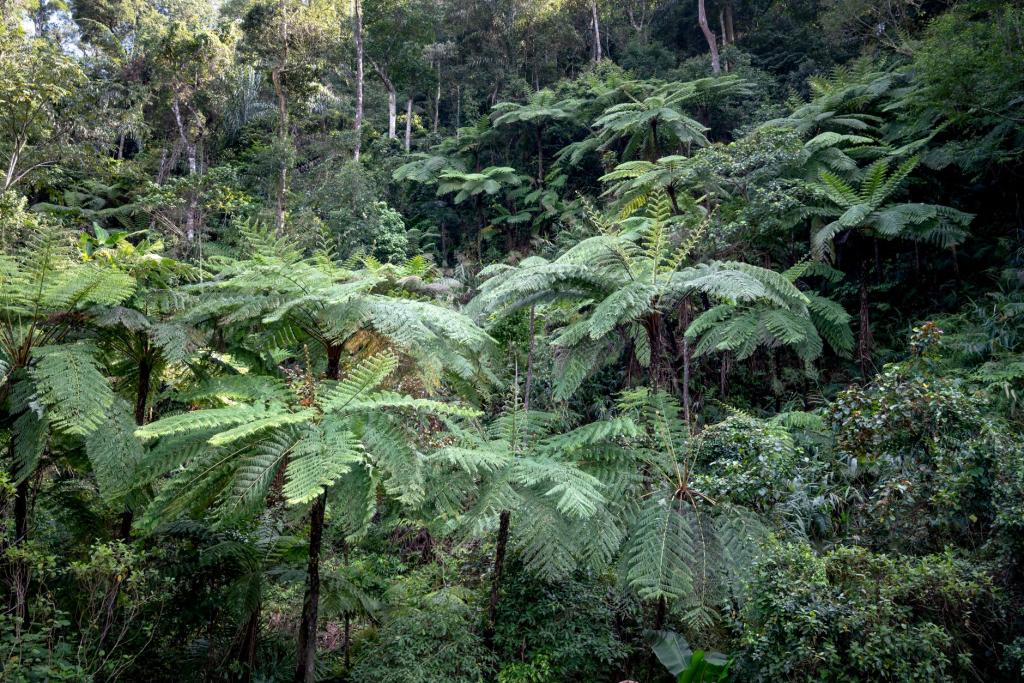
Drynaria lineatisora grows high up, in mountains between 840 and 2,400 meters along the southern edge of the Himalayas. The specimen used to define the species came from Medog County in Xizang, China, in a tropical broadleaf forest, where the fern grows on tree trunks rather than in soil. Botanists have also recorded it in northern Myanmar and northern Vietnam. Mountain forests are under pressure from a warming climate, and a Swiss experiment found that warm springs can shift the seasonal timing of trees by weeks.
DNA analysis of 84 chloroplast genes confirmed that Drynaria lineatisora sits on its own evolutionary branch, separate from Drynaria coronans. The genetic result matched what the sori, scales and spores had already suggested.
Why botanists kept getting it wrong
The researchers pointed to several reasons the mix-up lasted so long. Early specimens were scarce and often arrived without rhizomes, the underground stems that carry the scales, so the scale differences in Drynaria lineatisora could not be checked. Some specimens of Drynaria coronans also develop fused sori that look like the new fern's, creating forms in between. And many botanists worked from a small set of dried specimens instead of surveying living plants in the field.
Fieldwork in Medog County changed that. Jiang Liju of the Xishuangbanna Tropical Botanical Garden said the team found hundreds of individuals of Drynaria lineatisora across several townships there, and that the elongated sori showed up consistently, which supported treating the fern as a separate species.
The find adds a branch to the fern family tree. The researchers said it highlights how much biodiversity may still sit unrecognized in remote mountain regions. It joins other recent plant finds, including two rare new species described in the eastern Himalaya this autumn. For Drynaria lineatisora, the correction took nearly two centuries.
Comments 0
No comments yet. Be the first to share your thoughts!
Leave a comment
Share your thoughts. Your email will not be published.