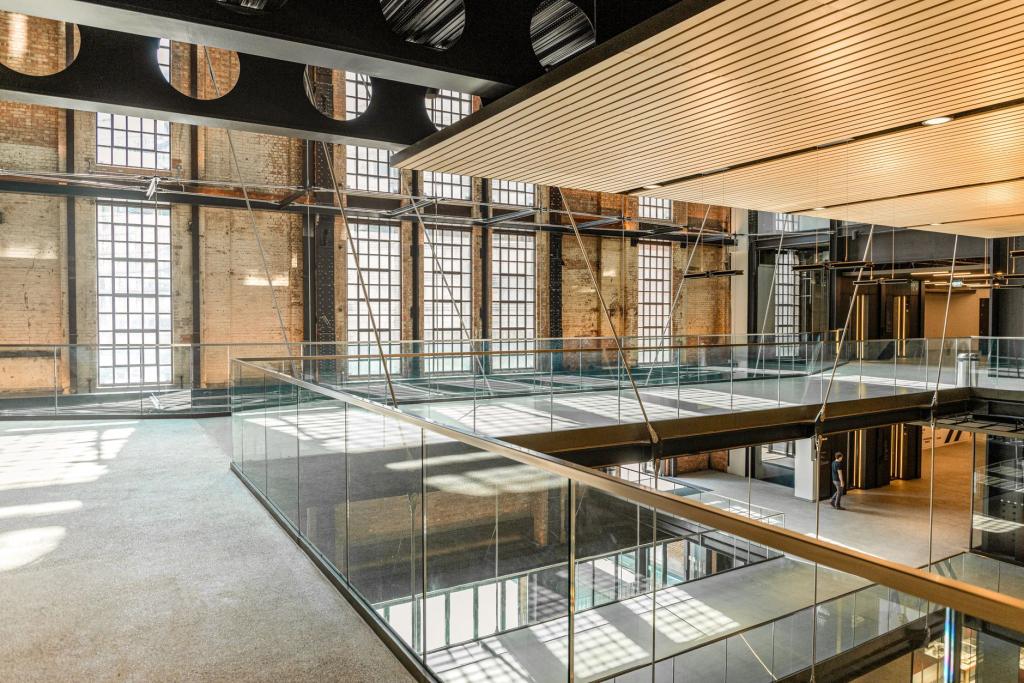
Apple announced on Tuesday the opening of Apple Music Hall, a new 600-capacity live music venue inside London's Battersea Power Station, in the same landmark building that houses the company's UK headquarters. Apple says the hall was designed so an artist can play an intimate show and, in the same room on the same night, capture a multitrack recording, mix it in Spatial Audio, and shoot multicamera video. Broadsheet reports the venue opens to the public on Monday, September 28, according to Broadsheet.
The room is built around closeness. Every seat is meant to feel near the performer, while the infrastructure behind the walls matches what a touring act would bring to an arena. The 38-foot-wide stage reconfigures between a traditional front-facing layout and in-the-round setups, so the room can shift its shape for different acts. A 48-speaker spatial sound system wraps around the audience, producing an immersive mix instead of the standard front-of-house feed. MacRumors reported that Apple is pitching the hall as a home for bespoke, intimate performances designed to connect artists and fans in ways few other rooms can easily match.
A stage that doubles as a studio
The real difference is what sits behind the stage: two professional recording and mix studios built into the venue. According to Apple, every performance can be captured as a multitrack recording and mixed in Spatial Audio, either live during the show or in post-production afterward. The venue is hardwired for 16 or more cameras that feed a purpose-built broadcast control room, and its infrastructure runs iPhone video capture in parallel with traditional broadcast cameras. AppleInsider reported that musicians will be able to walk out of a single show with a finished Spatial Audio recording, a broadcast-ready mix, and multicamera video in hand.
That combination turns one night at Apple Music Hall into a full pipeline: perform the gig, capture the recording, mix it, film it, and stream it to the world. Apple says shows from the hall can be livestreamed globally on Apple Music, which makes the London room function like a worldwide broadcast stage. For fans watching from far outside London, the stream is the point of the whole exercise.
Hypebeast reported that the hall gives artists production capabilities normally associated with much larger venues, even though the audience stays capped at six hundred. The practical appeal for an act is straightforward: instead of booking a separate recording session and a video shoot around a London gig, the show, the recording, and the broadcast package can all be finished on the same night. And because the hall sits underneath Apple's UK headquarters, the company's British offices now share a roof with a working concert venue.
A permanent home for a festival that lost its house
The building carries its own music history. Battersea Power Station, with its four chimneys and art deco details designed by architect Sir Giles Gilbert Scott, was the cover star of Pink Floyd's 1977 album Animals. The Grade II*-listed landmark sat largely dormant for nearly 40 years before reopening in 2022 as shops, offices, and housing. Apple's design for the hall nods to that heritage, with heritage brickwork, fluted arches, and bronze balconies that echo the station's oriel windows, plus a giant glass wall with a panoramic view of the concourse and the River Thames.
For Apple, the venue also closes a loop. The company's iTunes Festival began in London in 2007 and later became the Apple Music Festival, with its final editions staged at the Roundhouse in Camden. After that era ended, Apple had no permanent London home for live music. Apple Music Hall fills the gap, and it arrives as live music and streaming keep merging: a single show can now be a concert, a recording session, and a broadcast at once. It is the same kind of crossover that made headlines when Céline Dion's Paris residency turned a live stage into a global moment.
Oliver Schusser, Apple's vice president of Apple Music and International Content, framed the opening as a continuation of that history. "Apple's deep love for music dates all the way back to the very beginning, from the launch of the iPod to the long-running iTunes Music Festival to the debut of Apple Music," he said. "Today, with the opening of Apple Music Hall, we are once again taking an unprecedented step further in our commitment to artists and fans by supporting live music in ways only Apple can do."
What Apple is betting on is the gap between two experiences: the closeness of a small-room gig and the production muscle of an arena tour. Apple Music Hall is built to occupy that middle ground, with six hundred people in the room and a global audience on the stream. The opening caps a crowded September for the company, which unveiled its first foldable iPhone and shipped iOS 26 with tricks left out of the keynote. London gets a new venue on September 28. Everyone else gets the recordings.
Comments 0
No comments yet. Be the first to share your thoughts!
Leave a comment
Share your thoughts. Your email will not be published.