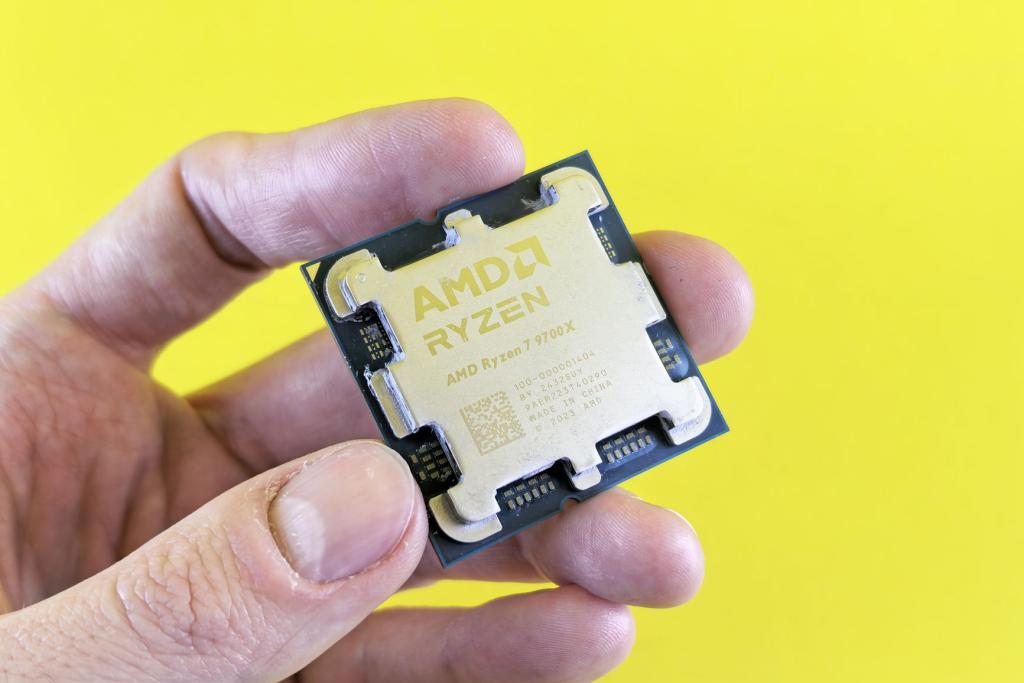
The chip giant just bought its way into a new era of AI
AMD agreed on Monday to buy World Labs, the spatial-intelligence startup founded by AI pioneer Fei-Fei Li, in an all-stock transaction valued at eight point two billion dollars. The announcement landed after United States markets closed on September twenty-eighth, and the companies said the AMD World Labs acquisition is expected to close by the end of next year, subject to regulatory approvals. It ranks among the biggest AI deals of the year, and it makes AMD's bet plain: the future of the industry is AI that understands the physical world, not just better chatbots.
As part of the deal, Li will join AMD as executive vice president and chief scientist, reporting directly to chief executive officer Lisa Su. Li is a Stanford computer science professor known widely as the godmother of AI, a nickname she earned by creating the ImageNet database that helped launch the modern deep-learning era. She founded World Labs in twenty twenty-four to build what she calls world models: deep-learning systems that do not just generate text or images but simulate and reason about three-dimensional space.
What AMD is actually buying
World models are still a loosely defined category, but the AMD World Labs acquisition comes with the clearest commercial pitch in the space so far. The startup's first product, Marble, turns a text prompt, a photo, or a video into an editable, explorable three-dimensional environment, with paid plans running up to ninety-five dollars a month, according to TechCrunch. On the first of this month the company released Atlas, a more advanced world model that can reconstruct a navigable three-dimensional scene from just a handful of photos. World Labs says Atlas is a stepping stone toward training robots in high-fidelity simulated environments rather than in the real world.
The ambition stretches well beyond entertainment. The company says its world models will eventually power robot training, scientific discovery, and factory simulation, which is a lot of ground for a startup barely two years old. Investors bought in anyway. World Labs raised one billion dollars in new funding in February from backers including AMD itself, Autodesk, Emerson Collective, Fidelity Management, Nvidia, and Sea, according to multiple reports. Autodesk separately invested two hundred million dollars and secured a strategic adviser role. As recently as January, the company was reportedly in talks to raise at about a five billion dollar valuation, so AMD is paying a steep premium for control.
The two companies were not strangers before this deal. AMD and World Labs formed an inference optimization and training partnership last year, and Li was a guest at AMD's CES presentation earlier this year. World Labs justified the deal in a statement saying that AI development required close collaboration across model research, systems and compute. AMD, in turn, said that understanding frontier workloads like the ones created at World Labs will shape its chip-making roadmap, according to TechCrunch's reporting on the announcement.
Why a chipmaker wants a research lab
Chip companies usually buy patents and product lines. With the AMD World Labs acquisition, AMD bought a research lab and the person running it. It is the company's second-largest purchase on record, behind only the roughly fifty billion dollar acquisition of Xilinx in twenty twenty-two. For a company that makes its money selling silicon, buying a model lab is an unusual move, and it shows how the AI hardware race is shifting. For AMD, the next AI market looks less like a contest over who sells the most graphics chips and more like a contest over whose hardware is tuned for the models that perceive the physical world.
Lisa Su laid out the logic in an interview with Bloomberg Television. "The more you understand end to end, the better system you are going to build," Su said in the interview, adding that the point of the AMD World Labs acquisition was to get access to the world-class talent Li had assembled and bring it together with AMD's capabilities around hardware, software and systems. Li echoed the hardware-software theme in the same interview, saying that joining forces with AMD gives the team, the company and the ecosystem an opportunity to accelerate what she called the flywheel between software and hardware development. For context on how quickly AI fortunes are shifting, see the earlier GenZNewZ piece on AMD's run to a one-trillion-dollar valuation.
The competitive pressure behind the AMD World Labs acquisition is not hard to read. Nvidia maintains a suite of open-weight world models such as Cosmos, according to reporting by Techstrong AI, while AMD had largely focused on text and video-based models. The AMD World Labs acquisition gives AMD direct access to frontier workloads in spatial intelligence, letting the chipmaker tailor its hardware, software and system architectures for the next generation of AI infrastructure. The industry now talks about physical AI as the coming battleground, covering robots, autonomous driving, digital twins and gaming, all of which need models that reason about real space rather than flat text.
The AMD World Labs acquisition also fits a broader pattern of AI labs and chipmakers collapsing into each other. OpenAI's frontier-model training pause, driven by fears over autonomous agents, has rattled the entire ecosystem, as reported by GenZNewZ yesterday, while Anthropic is racing toward a public listing that could value it near two trillion dollars, which GenZNewZ broke down in a deep dive on its IPO prospectus. Everybody in AI is scrambling to own more of the stack, and AMD just placed one of the boldest bets of the year that the stack's future is physical.
There are still questions. Regulators will scrutinize the AMD World Labs acquisition, and turning a small research lab into a product engine inside a giant chipmaker is far from guaranteed. AMD is no longer content to be the challenger that sells you the chips. With the godmother of AI now its chief scientist, it wants to define what the chips are for.
Comments 0
No comments yet. Be the first to share your thoughts!
Leave a comment
Share your thoughts. Your email will not be published.