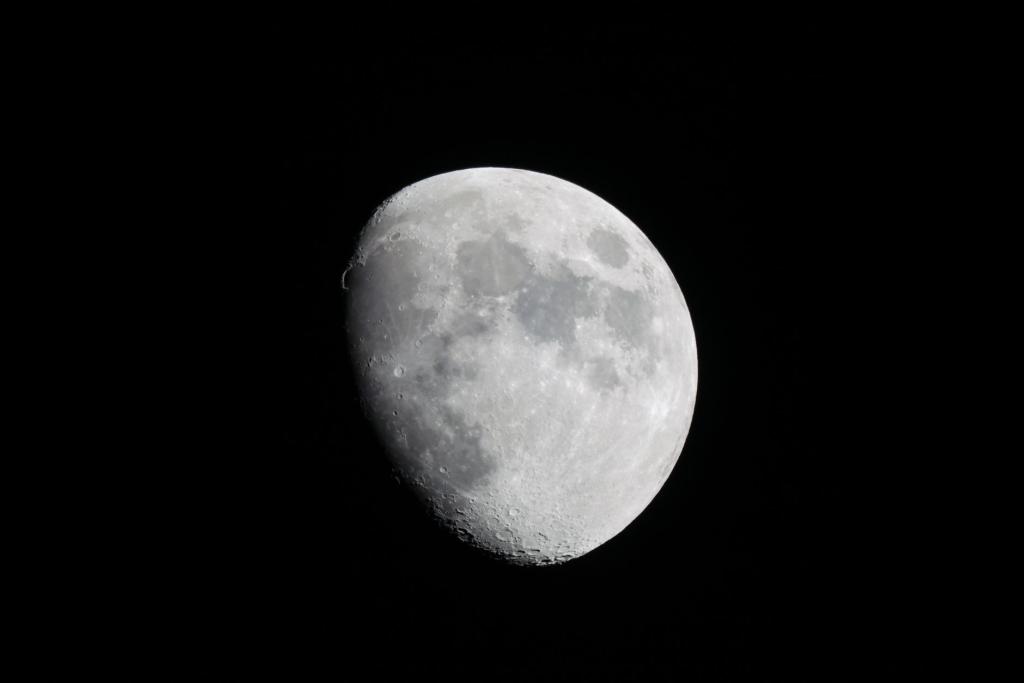
The moon has no magnetic field today, but its dust still remembers one. Scientists studying soil returned by China's Chang'e-6 mission have found a rare form of iron hiding in impact glass, a tiny lunar magnetic fossil that could record the moon's ancient magnetism. The discovery adds a new recorder to the moon's magnetic history, one that researchers did not know existed.
The work was led by professor Du Haifeng of the High Magnetic Field Laboratory at the Hefei Institutes of Physical Science, part of the Chinese Academy of Sciences, and published in the Proceedings of the National Academy of Sciences. According to the paper, the team examined glassy particles from lunar soil collected inside the South Pole-Aitken Basin on the moon's far side, the first material ever returned from that region. Using focused ion beam preparation, transmission electron microscopy and chemical analysis, they mapped nanoscale iron particles spread through the glass. Some of those particles were face-centered cubic gamma-Fe, and it was the dominant iron phase in the samples examined. This is the first time the gamma phase of iron has been found in natural lunar material.
An iron phase that should not survive
Iron normally turns up on the moon in its alpha phase. Gamma-Fe is the high-temperature version of the metal, the kind that converts into alpha-Fe as it cools. Finding it sitting stable inside lunar glass at ambient temperature was unexpected. The researchers suggest it survived because of the extreme conditions of the impacts that created the glass: trace amounts of carbon and other elements, the rapid freezing of impact-generated melts, and the glassy matrix wrapping each particle all appear to have locked the gamma structure in place.
"This tiny magnetic fossil may help us better understand the moon's ancient magnetic history," said Dr. Li Long of the Hefei Institutes of Physical Science, a member of the research team. The moon is an ideal place to hunt for records like this because its surface barely changes. Without wind or water to grind things down, the glass formed by each ancient impact just sits there, and that stillness is what let a delicate high-temperature iron phase survive long enough for scientists to find it.
A new recorder of ancient magnetism
The magnetic behavior is what makes the find matter. Just as other recent moon research keeps rewriting what scientists thought they knew (see our coverage of the JWST early galaxies heavy elements discovery), this result overturns an assumption about which minerals can preserve ancient magnetic signals. With off-axis electron holography, the team imaged the magnetic structure of individual gamma-Fe nanoparticles and watched the larger ones settle into a stable single-vortex state. Those particles kept their arrangement even when an external magnetic field was applied, which is exactly what a good magnetic recorder needs: a grain that holds its magnetization instead of losing it. That stability is what earns the find its nickname: a lunar magnetic fossil worthy of the name. The paper's significance statement notes that gamma-Fe can record remanent magnetization, the frozen-in magnetic signal scientists use to reconstruct ancient fields.
This lunar magnetic fossil also changes how researchers read samples they already have. Gamma-Fe turned up as the dominant phase in the glass the team examined, which suggests other lunar samples could be hiding the same mineral, unrecognized simply because nobody knew to look for it. Revisiting older Apollo and Chang'e material with that in mind could turn up more recorders, and each new lunar magnetic fossil would add another timestamp to the moon's magnetic timeline.
The discovery widens the known set of magnetic minerals on the moon, and this particular lunar magnetic fossil may be the first of several. Because gamma-Fe and alpha-Fe form under different conditions and carry different magnetic properties, the researchers report that each may preserve information from different stages of lunar impacts. Future studies will clarify how these minerals contribute to the story of the moon's magnetic past. Every new recorder pulled from the dust gives scientists another page of that history, and the authors write that integrating gamma-Fe into the known set of lunar magnetic carriers offers a fresh perspective on how the moon's magnetic field evolved.
For context, the paper's authors point out that metallic iron is one of the most widespread magnetic carriers on the lunar surface, and previous work had mostly found the alpha phase. That makes this lunar magnetic fossil a genuinely new addition rather than a variant of something already catalogued. Read the full report from the researchers at PNAS, or the summary at Phys.org.
Comments 0
No comments yet. Be the first to share your thoughts!
Leave a comment
Share your thoughts. Your email will not be published.