UNESCO intangible cultural heritage is not a monument, a protected landscape or a badge that makes a custom belong to an international organization. It is living knowledge and practice: things people teach, perform, adapt and recognize as part of their shared heritage. World Heritage, by contrast, concerns cultural and natural properties—places judged to have outstanding universal value. The distinction matters because a dance, craft or ritual stays alive through its practitioners, while a historic district or ecosystem needs place-based stewardship. UNESCO’s two systems use different conventions, nomination routes and measures of success.
Living practices are not the same as listed places
According to UNESCO’s 2003 Convention, intangible cultural heritage includes practices, expressions, knowledge and skills, along with related objects and cultural spaces, that communities recognize as their heritage. It is passed between generations but also recreated as people respond to changing circumstances. UNESCO groups examples under oral traditions, performing arts, social practices and festivals, knowledge about nature and the universe, and traditional craftsmanship. The emphasis is not on keeping a performance or recipe perfectly unchanged. The heritage is the knowledge and relationships carried forward through its practice.
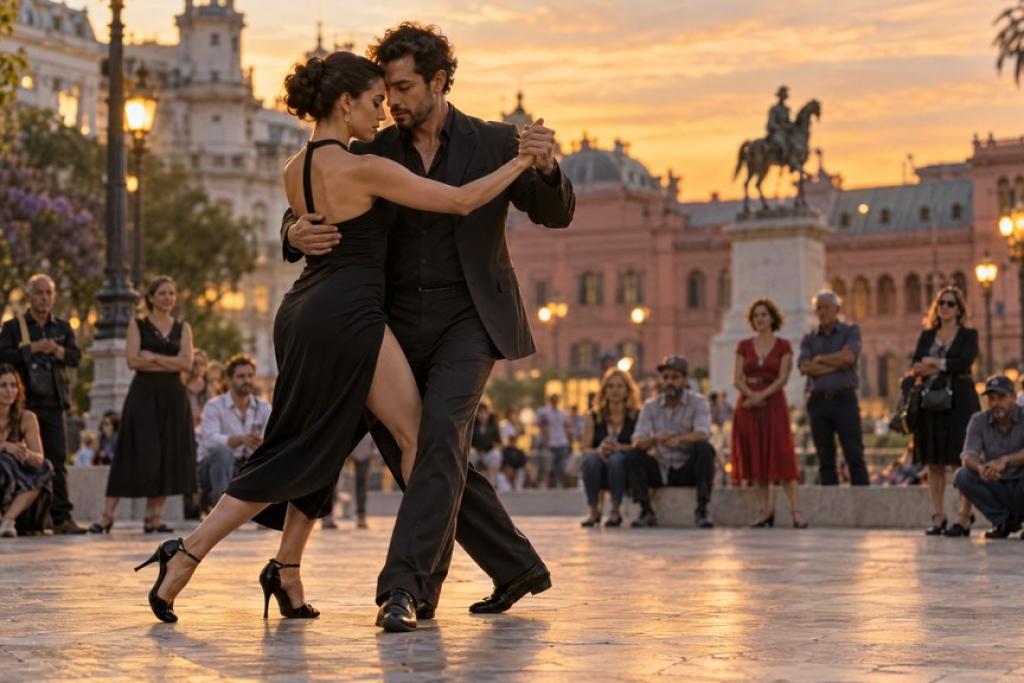
UNESCO’s entry for Tango makes the difference tangible. Inscribed on the Representative List in 2009 through a joint nomination by Argentina and Uruguay, tango is described as music, dance and poetry rooted in Buenos Aires and Montevideo and practised by a broad community of musicians, dancers, teachers and others. The entry notes that the tradition has spread and adapted. The listed element is therefore not a single dance hall or a frozen choreography; it is a changing cultural practice and the people who sustain it.
World Heritage uses a different frame. Under the 1972 World Heritage Convention, cultural heritage includes monuments, groups of buildings and sites, while natural heritage includes significant natural features, habitats and areas. A useful example is UNESCO’s Historic Centre of Rome, an extensive property that includes archaeological areas, monuments and layers of urban development. UNESCO records its inscription in 1980 and its cultural criteria. The object under consideration is a defined place and its values, not the everyday skills or customs of everyone who lives there.
These categories can meet in real life without becoming interchangeable. A historic square may host a festival; an old building may house craft workshops; a landscape may be central to local knowledge. The intangible heritage definition explicitly includes associated cultural spaces and objects, and the 2003 Convention recognizes the interdependence of tangible and intangible heritage. But listing a place does not automatically list every practice inside it, just as recognizing a practice does not turn its venue into a World Heritage property.
How the two nomination routes work
For intangible heritage, communities do not submit an application directly to UNESCO. A State Party to the 2003 Convention presents a nomination, and the process requires evidence that the relevant community had the widest possible participation and gave free, prior and informed consent. The element must also appear in an inventory maintained by the submitting state, and the file must set out safeguarding measures. According to UNESCO’s inscription criteria, these are requirements, not optional extras attached after a decision.
After evaluation, the intergovernmental Committee decides whether to inscribe the element. The Representative List is meant to show the diversity of living heritage and raise awareness of its importance; it is not a ranking of the world’s best or most authentic traditions. A separate List of Intangible Cultural Heritage in Need of Urgent Safeguarding is for elements whose viability is at risk and that need urgent measures. UNESCO says these inscriptions can help mobilize cooperation and assistance. There is also a Register for programmes and projects that demonstrate good safeguarding practices.
World Heritage nominations begin with a different gate. According to UNESCO’s nomination guide, the first mandatory step is for the country to place a property on its Tentative List. The State Party then develops a nomination file; UNESCO describes a preliminary assessment stage followed by a full dossier. ICOMOS evaluates cultural properties and IUCN evaluates natural ones, before the World Heritage Committee makes the final decision. A site must demonstrate Outstanding Universal Value and meet at least one of the ten selection criteria. Protection, management, authenticity and integrity also matter.
This is why the same word—“nomination”—does not mean the same test. For living heritage, a central question is whether a community recognizes the element, takes part in the process and has a credible plan to keep transmission viable. For a World Heritage property, the test centers on the place’s universal value, boundaries and long-term management. Neither route is simply a public vote or an online form, and neither promises automatic inscription.
What inscription can—and cannot—do
Inscription can make heritage more visible, encourage dialogue and bring attention to the need for care. For an endangered practice, an urgent-safeguarding nomination can link a state and community to international cooperation and assistance. For a listed site, the Convention supplies a framework for countries to work together and seek support. These are meaningful tools, but they are not magic shields. Listing alone cannot teach a young person a song, pay an artisan to pass on a technique, repair a roof or manage visitor pressure.
Nor does UNESCO take ownership of a listed tradition or property. The 1972 Convention says that the duty to identify, protect, conserve, present and transmit heritage located in a country belongs primarily to that State; it also says international cooperation does not take the place of the State’s action. National law and existing property rights remain relevant. For intangible heritage, the Convention calls on States to involve the communities, groups and individuals who create, maintain and transmit it in safeguarding and management. An inscription is recognition within a treaty system, not a transfer of title or a guarantee that harm cannot happen.
It is also a mistake to treat inscription as proof that an element is exclusive to one country or group. UNESCO describes intangible heritage as inclusive: related expressions can be shared across communities, adapted by migrants and practised in different settings. The nomination records the people and places involved in a particular proposal, but the list does not erase cultural exchange or settle every question of origin. That nuance helps avoid turning a safeguarding tool into a claim that only one community may dance, cook, speak or make something.
Why communities have to remain at the center
A living practice depends on more than a name in a database. It needs chances to be taught and learned, materials and spaces where relevant, time for practitioners, and room for communities to decide how the tradition changes. A safeguarding plan that photographs a technique but excludes its makers may document an activity without ensuring that it continues. UNESCO’s consent and participation rules matter because people who carry the knowledge are not just evidence for an application; they are the people whose choices determine whether transmission is meaningful.
Communities are not uniform, either. Generations, teachers, artists, minority groups and local institutions may disagree about what should be shared, how a practice is presented to visitors, or which parts are private. Good safeguarding makes space for that conversation rather than assuming that a committee or outside expert can define an authentic version once and for all. Where a tradition is under pressure, support should strengthen practitioners’ ability to teach and practise it, not push them into performing for outsiders or preserving a form they no longer use.
For readers comparing UNESCO intangible cultural heritage labels with World Heritage tags, a practical check is to ask three questions: What exactly has been inscribed—a practice or a place? Who nominated it, and what role did the affected community have? What concrete work is supposed to happen after the announcement? The answers separate recognition from protection and help reveal whether a list entry supports the people and places behind it. In both conventions, the strongest outcome is not the label itself but a durable commitment to care, with communities involved and states accountable for their responsibilities.
Comments 0
No comments yet. Be the first to share your thoughts!
Leave a comment
Share your thoughts. Your email will not be published.