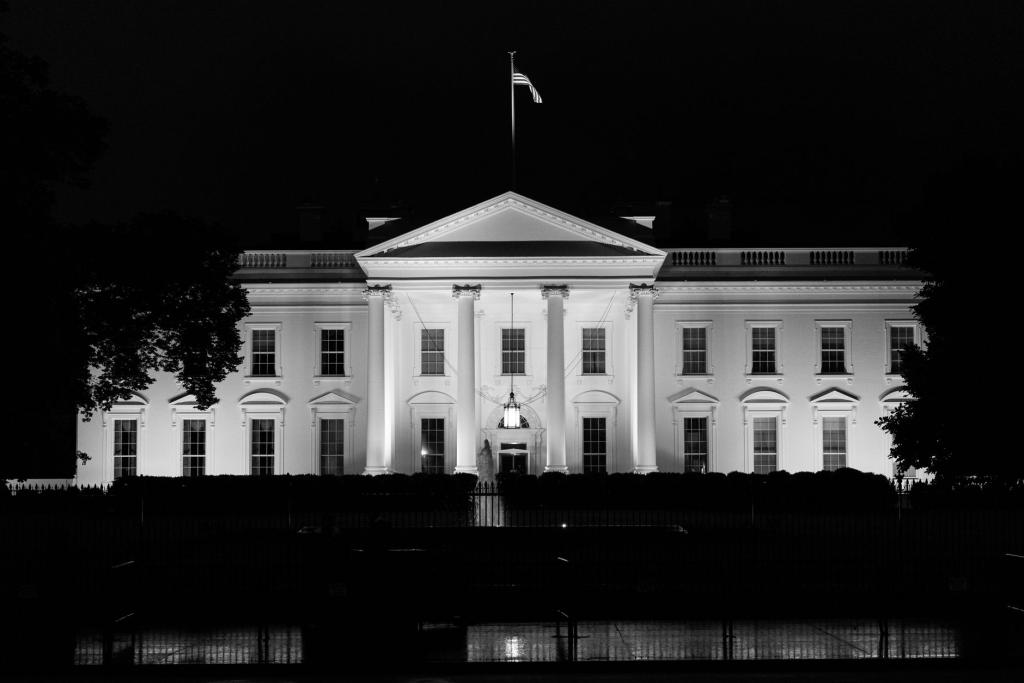
President Donald Trump and the CEOs of six of the world's biggest AI companies signed a voluntary AI self-regulation accord on Tuesday, September 29, committing the industry to police itself on AI safety — a deal Trump called "morally binding" even though it carries no legal enforcement.
The document, titled the "White House Accord on Super Intelligence: Joint Commitment on Frontier Responsibilities," was signed at a lunch in the East Room of the White House attended by nearly two dozen tech leaders. The six CEO signatories are Dario Amodei of Anthropic, Sundar Pichai of Google, Mark Zuckerberg of Meta, Greg Brockman of OpenAI, Jensen Huang of Nvidia, and Elon Musk of xAI, according to reporting by the Associated Press.
According to a copy of the AI self-regulation accord, the companies agreed to "four layers" of safeguards: establishing robust internal controls to monitor risks to cybersecurity, biosecurity, and chemical threats; ensuring models do not hack or access technical systems in unintended ways; partnering with an independent external auditor to assess whether the controls are working; and designating a board-level committee at each company to evaluate reports from internal and external auditors.
"There's a belief that there should be tremendous self-regulation, and we automatically have regulation with the Department of Justice, the FBI, all of that," Trump told reporters in a brief appearance with his guests. "But the self-regulation is very important." After the lunch, Trump walked the executives onto the West Wing driveway for a 33-minute impromptu press conference, where he likened the one-page accord to "almost like a constitution in a way."
What the accord actually requires
The substance of the AI self-regulation accord is four voluntary steps. The companies will implement robust internal controls, submit to assessments by an independent external auditor, create board-level oversight committees, and meet regularly to establish safety standards. The text of the AI self-regulation accord was posted by Trump on his Truth Social account late Tuesday.
Notably, the AI self-regulation accord does not name an auditor, set a timeline, or include any enforcement mechanism. It does, however, open the door to future regulation: "Over time, it may make sense to codify these steps into laws and regulations," the accord reads. That single sentence is doing a lot of heavy lifting for a document critics say is mostly vibes.
In the same news cycle, Trump signed an executive order requiring federal agencies to refer to the technology as "Super Intelligence" rather than artificial intelligence — an effort to counter increasingly negative public perceptions of AI, reported by USA Today. Trump has in recent weeks dismissed fears of catastrophic AI risk as "a hoax," making the engagement on safety a notable, if limited, shift.
The lunch behind the AI self-regulation accord was a study in political theater. Before the meal, Trump posted a seating chart on Truth Social with Huang and Musk, the world's richest person, flanking him. Attendees also included Microsoft CEO Satya Nadella, AMD CEO Lisa Su, Palantir CEO Alex Karp, and House Speaker Mike Johnson, according to a list released by the White House.
Why critics aren't buying it
Skeptics were blunt. "What other trillion-dollar industry marks its own homework?" asked Toby Walsh, chief of the UNSW AI Institute. AI expert David Krueger of the University of Montreal described the move as the administration's "regulate without regulating" approach — everything ostensibly voluntary, nothing actually binding.
The timing is political. Polls show Americans have grown rapidly more wary of AI's risks — including job loss, higher electricity costs from data centers, and major cyber attacks — threatening to put Trump on the wrong side of the issue ahead of November's midterm elections. The lunch came days after Trump's first private sit-down with Amodei, who has been the industry's loudest voice for caution: in a September 12 essay, the Anthropic chief pledged to slow development of the most advanced models and urged more regulation, a stance Trump had publicly opposed.
Even Amodei, standing beside Trump on the driveway, offered a careful caveat. "The technology has very real risks," he said. "We all need to work together to make sure that we can win and we can win safely if we do this right." Speaker Johnson acknowledged Congress "potentially" will need guardrails but cautioned it would take "some time" to fashion legislation with broad enough support.
For Gen Z, the stakes of the AI self-regulation accord are concrete: the jobs market you are entering, the cost of the electricity powering your devices, and the data centers being built in communities across the country all flow from how AI is governed. The AI self-regulation accord may read like a handshake deal between a president and six billionaires, but it is a story worth understanding — and worth watching to see whether it ever becomes more than a handshake. Read the Associated Press's full account via WAMC/NPR.
For more on this story and others like it, follow our latest coverage and browse the newest GenZ NewZ stories.
Comments 0
No comments yet. Be the first to share your thoughts!
Leave a comment
Share your thoughts. Your email will not be published.