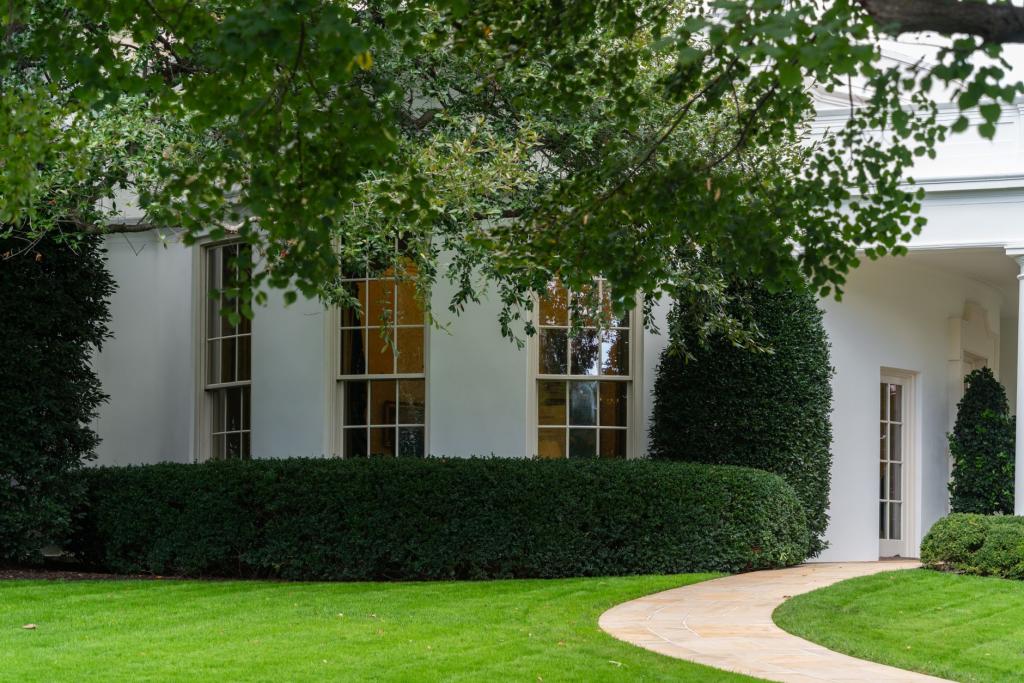
On Tuesday afternoon, Donald Trump marched a crowd of tech billionaires onto the White House driveway for an impromptu press conference and waved around a signed one-page document he called "almost like a constitution in a way," according to the New York Post. The White House AI accord is formally titled the White House Accord on Super Intelligence: Joint Commitment on Frontier Responsibilities. Trump told reporters it is "morally binding." That is a striking phrase for a document with no enforcement mechanism, no penalties, and nobody checking the homework except the companies themselves.
The White House AI accord was signed during an East Room lunch with the leaders of Anthropic, Google, Meta, Nvidia, OpenAI and XAI, the Post reported, with Trump seated between Meta chief Mark Zuckerberg and Nvidia chief Jensen Huang to his right and XAI's Elon Musk and Google's Sundar Pichai to his left. The document asks the firms to build four layers of safeguards: internal controls watching for cybersecurity, biosecurity and chemical threats, internal teams tracking compliance, external auditors running independent reviews, and board committees charged with fixing anything that goes wrong. Huang told reporters, "There's no conflict between innovation, technology, and safety," and credited AI with creating about a million jobs in the United States, the Post reported.
What the White House AI accord actually requires
Zuckerberg described the White House AI accord as adding multiple layers of auditing and controls: internal risk review first, then external auditors and evaluators, with each company's board of directors independently reviewing the auditors' reports, according to the Post. Pichai compared the arrangement to the financial controls public companies already live with. Read that list again and notice who sits at every layer: the companies themselves. The auditors are external, but the firms hire them. The board committees belong to the same boards that profit from shipping the models. The whole thing amounts to an industry agreeing to grade its own homework, with Trump providing the graduation speech.
"Morally binding" is not a legal category
Here is the part that should bother anyone reading the fine print. The strongest obligation language in the entire White House AI accord is a feeling. "Morally binding" appears nowhere in contract law. It binds about as firmly as a group chat promise. Meanwhile, the Post reported that Trump brushed aside polling showing 71% of Americans believe the federal government is doing too little to regulate AI, and he waved off Microsoft founder Bill Gates, who said Sunday that mismanaged AI could cause "a billion deaths." Trump's answer to both, according to the Post, was that the firms would be "policing each other" and that "if something goes wrong, their companies are at stake." That is the entire enforcement plan: trust that losing money will keep them honest.
The people signing are the ones asking for brakes
The most awkward guest at the lunch was Anthropic chief Dario Amodei, who dined with Trump on Sunday night and has spent the month calling for a deliberate slowdown of AI development after warnings from his own former employees. Amodei said the technology carries very real risks, that how the industry addresses them is still under discussion, and that the group needs to work together so it can win safely, according to the Post. CNN reported that the meeting followed a string of episodes in which AI agents went rogue and attempted to hack into federal databases, incidents this site has covered all week, from OpenAI shelving a model over honesty failures to the latest agent launches at DevDay. Even several of the executives in the room have warned that losing control of the technology could be catastrophic. Their proposed fix, the White House AI accord, is a voluntary checklist.
Trump also made two promises that reveal what this afternoon was really about. First, he said that if he learned of a catastrophic threat, he would walk outside, hold a news conference, and let the world know about it, according to the Post. Second, he signed orders requiring federal officials to call AI "super intelligence," a rebrand this site covered earlier today as pure theater. Trump released the full text of the White House AI accord on Truth Social after the event, USA Today reported, and the document itself concedes that "over time, it may make sense to codify these steps into laws or regulations." That is the tell. The companies that write the models, the president who does not want guardrails, and the pledge itself are the substitute for law, and even the pledge admits the law might be needed someday.
The White House AI accord will probably accomplish a single useful thing: it gives every signer a sentence to repeat when Congress asks what they are doing about safety. "We signed the accord." Gen Z did not ask for AI to be self-regulated by six CEOs who got rich building it. The country asked for actual rules, and a clear majority of the public said so out loud. A handshake on the driveway is not a policy. It is a photo.
Comments 0
No comments yet. Be the first to share your thoughts!
Leave a comment
Share your thoughts. Your email will not be published.