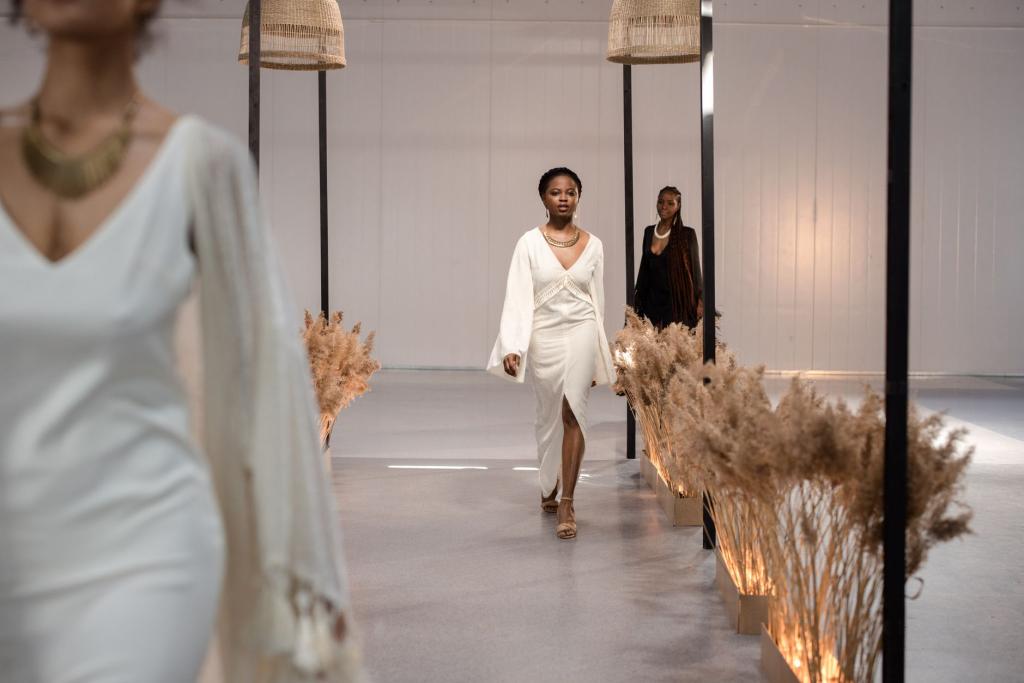
New York Fashion Week closed on September 15, but one of the season's most talked-about styling moments was not a silhouette, a color, or a bag. It was the absence of shoes. Across the Spring 2027 shows, models at Jane Wade, 6397, LoveShackFancy, 7 For All Mankind and Tory Burch all took their walks with bare feet, and the barefoot runway trend quickly became fashion-week lore.
At Jane Wade, a handful of shoe-free looks underscored the outdoorsy spirit of the Spring 2027 collection, while LoveShackFancy sent out barefoot dancers to channel a '90s hippie mood in its salon-style presentation, according to Fashionista's reporting on the season. One model at 6397's debut show walked with what looked like sand on her toes. At 7 For All Mankind, models strutted in towering Y2K-era platform pumps, only for one to return for the finale without them at all.
The catch is that most of it was never planned. Tory Burch told Fashionista's editor-in-chief that her show's single barefoot model had simply not received her shoes in time, and the designer reportedly laughed the mistake off with a backstage remark that bare feet were the new neutral. The mishap was honest, but to a casual viewer it read as intention, which raised the question of whether other houses, facing their own shoe predicaments, simply put a spin on theirs.
That spin found fertile ground. Just weeks earlier, Matthieu Blazy had introduced viral "barefoot sandals" for Chanel at the label's Cruise 2027 show, a look later co-signed by actor Margaret Qualley. With a major luxury house having already made shoelessness feel editorial, New York's foot-forward moments slotted neatly into a story the fashion press was ready to tell.
Why bare feet read as an aesthetic
Barefoot on a runway is a paradox: it looks effortless in an industry built on effort. The barefoot runway trend tapped into a visual language Gen Z already speaks fluently — lo-fi authenticity, festival-era hippie nostalgia, and the kind of grounded, touch-grass energy that has powered everything from indie sleaze revivals to the softer mood dressing of recent years. A bare foot on marble reads as freedom from the machinery of fashion, even while standing on a catwalk.
That reading is why the moment traveled so well online. Fashion week has always been content, and a barefoot model mid-stride is a perfect scroll-stopping image: strange enough to share, pretty enough to save. The look echoed the outdoorsy and bohemian notes elsewhere this season — the '90s hippie aesthetic at LoveShackFancy, the earthy practicality of Jane Wade's collection — and it fit the broader romance with undone dressing, where visible ease is itself a luxury signal.
There is also a longer lineage. Barefoot runway walks have surfaced periodically as deliberate statements about purity, nature, or craft, and luxury houses have long played with trompe l'oeil footwear, including Blazy's Chanel sandals, which mimic the look of a naked foot while still protecting it. The difference this season was the ambiguity: nobody could quite tell which moments were concept and which were chaos.
The safety problem behind the styling
Beneath the aesthetic chatter, the barefoot moments pointed to a less glamorous issue: too many models are being asked to walk in footwear that puts them at risk. Across Fashionista's Spring 2027 reporting, multiple editors witnessed stumbles and full falls caused by difficult shoes.
The incidents piled up across the schedule. For the final look of Henry Zankov's debut collection for Diane von Furstenberg, a model in platform heels fell after her billowing train swept under her, with high winds on The High Line making her gown unruly. At Area, one model stumbled, another finished her walk carrying her kitten heels at her side, and a third kicked hers off mid-finale, with attendees saying the shoes appeared to be falling apart. A carpeted runway made a Retrofete model wobble, and Luar's cobblestone-like catwalk at the Queens Museum was flagged as a twisted-ankle risk.
The pattern suggests that many of the season's shoeless moments were not styling at all but self-preservation: models faced with a choice between kicking off the shoes or risking a fall. That reframes the whole aesthetic conversation. What the audience read as a bold anti-shoe statement may have been, in several cases, a quiet act of workplace judgment by young women protecting themselves on treacherous surfaces.
As the spring/summer 2027 season rolls on — London Fashion Week opened this week with its own set of designer debuts — the industry has a genuine question to answer about backstage safety. Ensuring models can walk a runway without falling is a basic obligation, not a creative choice.
The barefoot runway trend also says something about how trends get made now. The runway did not declare shoelessness a trend; the audience did, by interpreting accidents as intention and dressing them up as aesthetic philosophy. In an era when every look is photographed, clipped, and memed within minutes, meaning arrives faster than the press release — and sometimes the most viral moment of fashion week is the one nobody designed.
Comments 0
No comments yet. Be the first to share your thoughts!
Leave a comment
Share your thoughts. Your email will not be published.