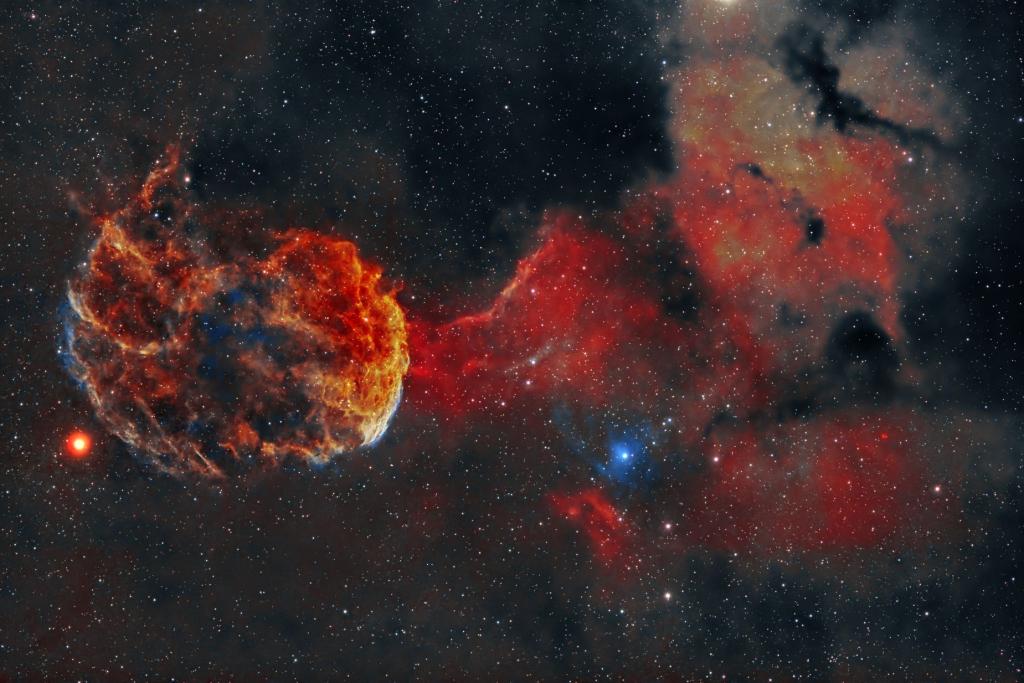
A Supernova Neutrino Glow from every collapsed star in cosmic history may finally be coming into view, after a giant underground detector in Japan reported its strongest hint yet of the faint signal. The result, posted as a preprint, describes a small excess of ghostly particles that matches what astronomers expect from the accumulated explosions of stars across the universe. It is not a discovery, and the team behind it says so plainly, but after decades in which searches returned only upper limits, a real excess is a landmark in itself.
The signal in question is the diffuse supernova neutrino background, a whisper of particles left behind by all the massive stars that have ended their lives in collapse. Unlike light, which can be blocked or fade, these particles travel almost untouched through space and matter, carrying a record of stellar deaths that telescopes never saw. A firm measurement would let astronomers count how often stars have collapsed, including the quiet collapses that form black holes without a bright explosion, and test what happens in the instant a core becomes a neutron star or a black hole.
How the hint was found
Super-Kamiokande is a vast tank of ultrapure water buried under a mountain, watched by thousands of light sensors that catch the faint flash produced when a particle interacts in the water. The new analysis pulls together observations from late 2008 through early 2026, combining an earlier pure-water phase with a later phase in which a rare-earth additive was dissolved into the water to tag neutrons more cleanly. That chemical change matters because the key interaction leaves behind a neutron, and a clearer neutron tag helps separate genuine events from the far larger wash of ordinary background noise.
The team also tightened its handling of other backgrounds, including particles from the atmosphere and short-lived radioactive products, and it refined the way it fitted the energy spectrum of the events. The excess it found sits in an energy window from 13.3 to 81.3 million electron-volts, exactly where the background is expected to appear, and the best fit points to a flux of about 3.6 particles per square centimetre per second above the lower edge of that window. The statistical strength of the excess is 2.6 sigma, a level that means the pattern is unlikely to be a fluke but falls well short of the bar the field requires before calling anything a discovery.
Hiroyuki Sekiya, the spokesperson for the collaboration, called the result a deeply meaningful achievement and a long-held goal since the project began, while stressing that more data and better analysis are essential before anyone can claim a definitive detection. That caution is central to the story: the same measurement that excites physicists also sets its own limit, and the team has said it will keep observing and refining the analysis rather than rushing to a stronger claim. Readers should treat the finding as an indication, the word the preprint itself uses, not as a settled detection.
Why a whisper matters
The value of the hint lies in what a confirmed signal would unlock. Today, astronomers learn about stellar deaths mainly from the bright explosions they happen to catch, which biases the record toward the loudest events. A neutrino background would fill in the silent majority, giving a census of collapse across cosmic time and a check on models of how stars live and die. It would also offer a new way to study the physics of the collapse itself, since neutrinos escape from deep inside the dying star while light is trapped behind collapsing matter.
There is a counterpoint worth keeping in mind. A single excess at this strength could still fade as more data arrive, and different models of the expected signal give somewhat different fits, so the result needs independent scrutiny and, ideally, confirmation from a larger successor detector now being built. The collaboration says similar strengths appeared under different model assumptions, which reduces the worry that the hint depends on one narrow guess, but model dependence cannot be removed entirely until the signal is strong enough to stand on its own. That is why the next phase matters more than the headline: continued running, combined with the successor instrument, should either lift the excess into discovery territory or show it for what it is. Long-running studies in other fields show the same patience paying off, as in research on how one extra school year cut dementia risk decades later.
The timeline also helps explain why this moment arrived now. The detector has been hunting this background since the nineteen-nineties, and earlier searches could only set ceilings on how strong it could be. The additive upgrade, better background rejection, and a dataset spanning well over a decade together pushed sensitivity past the point where an excess could finally show up. Other recent reporting has tracked how quiet corners of science can suddenly open up, including work on silent soil bacteria that may yield cancer drugs, and the pattern is similar here: patience, a better tool, and a long dataset can turn a limit into a lead.
For the wider public, the Supernova Neutrino Glow is a reminder that the night sky is not only what we see. Beneath the visible stars lies a particle sky, built up over billions of years from explosions no human ever witnessed, and we are only now learning how to listen to it. If the excess holds, future textbooks will describe a universe whose history can be read in particles as well as light. If it fades, the search will still have sharpened the tools and the methods for the next attempt, and the successor detector will inherit a far better map of the noise it must beat. Either way, the Supernova Neutrino Glow has moved from a theoretical whisper to a measurable question, and that is why astronomers are paying attention.
According to reporting on the preprint, the collaboration previewed the result at a major neutrino conference last summer before posting the full paper, and a second account notes the same energy window and the same caution about the discovery threshold. The two accounts agree on the essentials: a real excess, a careful team, and a long road to proof. That agreement, plus the team's own restraint, is what makes this hint worth reporting now, even though the final verdict is still years away.
Comments 0
No comments yet. Be the first to share your thoughts!
Leave a comment
Share your thoughts. Your email will not be published.