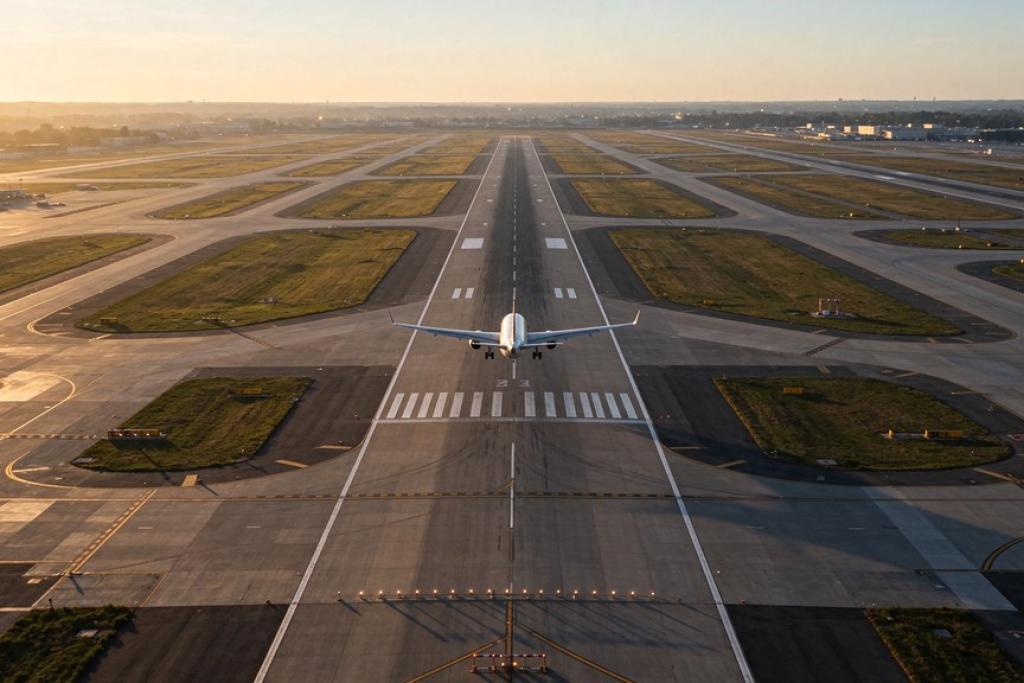
Runway numbers are rounded magnetic headings, not measurements of a runway’s length. A pair such as 09 and 27 labels opposite directions along the same strip of pavement: the first direction points roughly east, while the other points roughly west. The numbering gives pilots and air traffic controllers a concise, shared reference for a runway’s orientation.
How a magnetic heading becomes a runway number
According to the FAA’s Aeronautical Information Manual, runway numbers are determined from the approach direction. The number is the whole number nearest one-tenth of the runway centerline’s magnetic azimuth, measured clockwise from magnetic north. In everyday terms, take the compass direction in degrees, round it to the nearest ten degrees, then drop the last zero. A runway aligned to about 090 degrees is therefore numbered 9; one aligned to about 270 degrees is numbered 27.
Here is the reciprocal example step by step. Imagine an aircraft approaching a runway end along a magnetic azimuth of 087 degrees. Rounding 87 to the nearest ten gives 90, so that end is Runway 9. The other end points 180 degrees away: 087 plus 180 is 267 degrees. Rounded to 270, it is Runway 27. Together they are commonly written as 09/27, with the two designations 18 numbers apart. The paired numbers describe opposite directions, not two different runways.
There is a small notation detail: people often write a leading zero in shorthand, as in “09/27,” because many aviation references display two digits. According to the FAA’s airport-marking circular, a single-digit number painted on a runway is not preceded by zero, so the pavement marking itself reads “9,” not “09.” The same circular notes a tie case: when the azimuth ends exactly in five degrees, such as 185 degrees, the designation may be either 18 or 19. That midpoint allowance is why the simple round-to-the-nearest-ten rule has a narrow exception.
Why parallel runways get L, C and R
Large airports can have two or more runways running in the same direction. Their magnetic orientations may be so similar that the rounded number alone would be identical. To distinguish them, FAA standards add a letter based on the pilot’s approach view: L means left, C means center, and R means right. The FAA Advisory Circular on Airport Markings gives examples: two parallel runways can be marked 18L and 18R, while three can be 9L, 9C and 9R.
Those letters are relative to the direction of approach, not a permanent left or right on a map. Turn around to use the opposite end, and the aircraft’s left and right viewpoints reverse. Airport diagrams, runway signs, pavement markings and air traffic control phraseology all need to make clear which particular strip is in use. The distinction matters at airports where several aircraft may be taxiing, taking off or landing near one another.
Why runway numbers can change over time
The numbers refer to magnetic direction rather than a fixed geographic bearing relative to true north. Earth’s magnetic field changes gradually, so the magnetic azimuth assigned to a runway can drift even though the concrete and asphalt do not move. If the updated magnetic direction rounds to a different ten-degree value, an airport may renumber the runway. In other words, a runway can keep the same physical orientation yet receive a new designation after a magnetic-variation update.
FAA procedure records show what that looks like in practice. An FAA aeronautical procedure document for Winters Municipal Airport in Texas says its runways were to be renumbered from 17/35 to 18/36 as the airport’s assigned magnetic variation changed. A separate FAA record for Crater Lake/Klamath Regional Airport in Oregon documents Runway 7/25 becoming 8/26 as the assigned variation changed from 17 degrees east to 14 degrees east. These are not runway extensions or relocations; the records connect the new labels to updated magnetic-variation data.
Changing a number is more than repainting two digits. The FAA’s NOTAM examples show a runway-renumbering notice that updates an instrument procedure and gives “runways renumbered for magnetic variation change” as the reason. At Tucson International, an FAA-hosted airport update described planned runway changes and said signs, markings and approach procedures would be updated to match. Consistent labels matter across charts and procedures as well as on the ground, so pilots and controllers are referring to the same runway designation.
For travelers, runway numbers are most useful as a glimpse of the system behind airport operations. They help aviation professionals identify runway direction and distinguish parallel pavement; they do not tell passengers where to walk, which aircraft to board or what to do during a flight. Follow airport signs and crew instructions rather than treating a runway number as a passenger direction. Once you know the pattern, 09/27 is easy to decode: one strip, two opposite magnetic headings, rounded into a compact pair of labels. For another travel-related calendar quirk, see GenZNewz’s International Date Line explainer, which describes why a long flight can arrive on a different local date.
Comments 0
No comments yet. Be the first to share your thoughts!
Leave a comment
Share your thoughts. Your email will not be published.