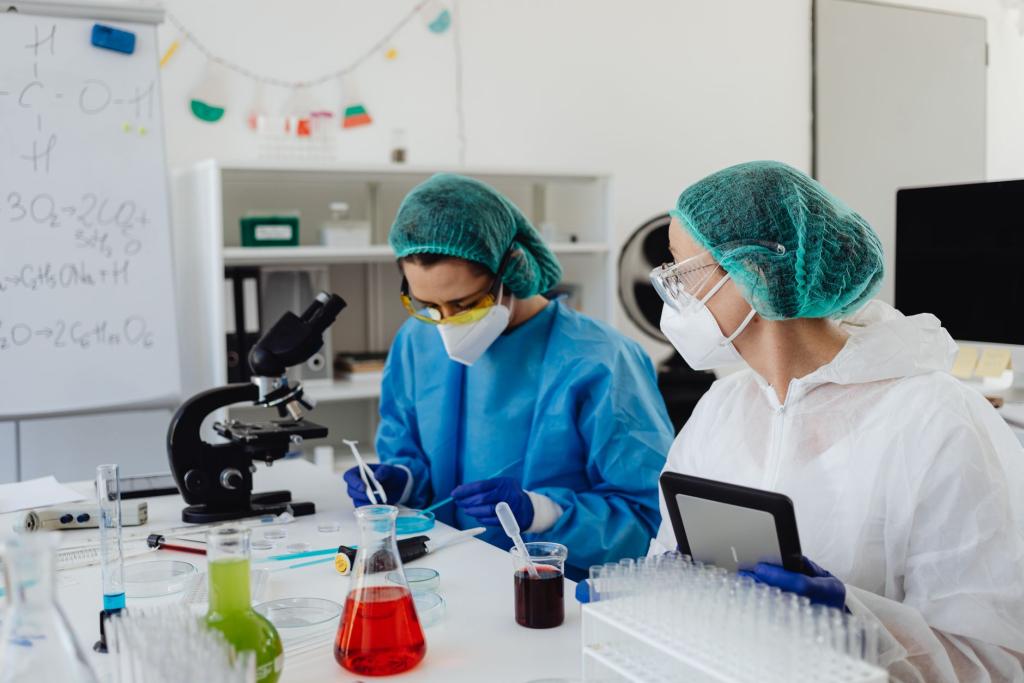
OpenAI is offering eligible U.S. university labs a year of free business-tier AI seats plus a shot at its most specialized science model. The company introduced the Rosalind Academic Plan on October 15, 2026, giving approved labs up to 30 ChatGPT Business Standard seats at no charge for up to a year, with access to GPT-Rosalind subject to trusted-access approval.
The Free Seats allocation covers the full set of commercially available frontier models within the plan's usage limits, including ChatGPT and Codex. OpenAI's announcement states that research data shared through the plan is not used to train its models by default, a policy aimed at researchers who work with unpublished findings they cannot afford to see recycled into a chatbot's answers. GPT-Rosalind, the company's dedicated life-sciences model, is named after Rosalind Franklin, the chemist whose X-ray diffraction images helped reveal DNA's double-helix structure.
GPT-Rosalind pairs frontier reasoning with the Rosalind Workbench, a tool-orchestration layer that spans medicinal chemistry, genomics and wet-lab assistance. In benchmarks reported by AI coverage of the model, it posted gains of 53.7 percent on Genebench, 18.0 percent on Medchem Bench and 19.6 percent on Labworkbench versus existing baselines. That specialist edge is exactly what university biology labs have been asking about since the model first appeared as a research preview on April 16, 2026.
What the free seats actually include
According to OpenAI's help center guide, each complimentary seat covers ChatGPT and Codex under their existing usage limits, and the free offer does not lift those caps. A payment card is still required during setup even though nothing is charged during the complimentary year. The plan includes no API credits or API usage, and approval does not unlock GPT-Rosalind through the API either.
There are more strings attached than the headline suggests. Participating labs work inside a managed business workspace where standard data retention applies by default, and the offer does not support zero data retention, according to OpenAI's help center. The verified principal investigator or lab lead becomes the sole workspace owner and cannot appoint additional owners or administrators. Joining the workspace alone grants nobody access to the biology model; the PI or lead must switch it on for each member individually. Every member needs a verified institutional email on the same domain as the approved lab head, which rules out visiting researchers and collaborators at other institutions.
Application runs through a trusted-access review rather than a simple sign-up. PIs and lab leads sign in with a ChatGPT account tied to a university email, verify it, and submit their institution, department, lab details, research focus and intended use of the model. The review uses Persona to check identities, and applicants must name a trained biosafety contact designated by their institution's environmental health and safety or biosecurity office. OpenAI says access can be revoked if its safety monitoring or responsible-use requirements stop being met.
Guardrails, gatekeeping and what's missing
The October announcement lands in a longer rollout. GPT-Rosalind moved from research preview to broader trusted-access availability on September 11, 2026, with discovery-tier pricing set around five dollars per million input tokens in early October. The academic plan follows that expansion by removing the price barrier for campus labs, though not the approval barrier.
That gating is the point. A biology model that can design candidate drugs and therapeutic proteins has obvious dual-use weight, and OpenAI framed the release with safeguards for sensitive work. Its announcement publishes a side-by-side example in which GPT-Rosalind produced a candidate comparison matrix, a modeling plan and paired study plans for an antiviral research request, while the general-purpose Mainline Astra model withheld sequence-level designs and experimental detail. OpenAI notes that its published assessments check whether the requested deliverables were addressed in text, not whether the science is correct or feasible.
The gatekeeping cuts both ways. Labs that already hold an OpenAI enterprise agreement cannot use the academic plan at all; they must request model access through their university's enterprise channel instead. Commercial organizations and unaffiliated researchers are excluded outright. And while the offer puts frontier models on lab machines cheaply, it keeps the biology model itself behind approval and keeps API workflows off the table entirely, which limits labs that have built pipelines around programmatic access.
OpenAI is not the only frontier lab courting scientists. Coverage of the space has noted Anthropic's Claude Science workbench as a competing platform for research workflows, and recent weeks have shown both companies racing to embed their models in professional tooling. Google's latest flagship model is now reaching paying subscribers, which shows how fast the frontier is becoming table stakes. That makes free campus access a recruiting move as much as a research gift.
Why this matters on campus
For principal investigators, the Free Seats offer removes a budget line that has been growing for years: licensed AI seats for every grad student, postdoc and staff scientist in the lab. For early-career researchers, it puts the same frontier models on their machines as their better-funded peers without waiting for a departmental purchase order. OpenAI's announcement names labs already using the model, including the Zhao Lab at UCSF on quantitative drug development and work on neurodegeneration from the Bourdenx Lab, and says more labs get to apply now.
OpenAI published a comment from Dr. Brian Hie of Stanford University and Arc Institute: "Rosalind will not only help us improve our current discovery and design tasks, but also apply them at larger scales than previously possible while still providing useful insights to biological researchers." At UCSF, the Zhao Lab reported that the model helped it gather drug physicochemical parameters faster across a set of compounds while separating predicted from experimentally measured values.
There is a broader context worth keeping in mind. Federal regulators are already pressing OpenAI on AI safety practices, and safety researchers have separately urged labs to physically isolate powerful models. An academic rollout with a biosafety contact, domain-locked seats and post-activation monitoring is OpenAI's answer to that pressure: campus science, but on rails. Labs can learn more in the company's official announcement and the detailed help center guide, while independent reporting on the program is available from Unite.AI.
Comments 0
No comments yet. Be the first to share your thoughts!
Leave a comment
Share your thoughts. Your email will not be published.