If you have ever pressed your ear to an apartment wall to figure out whether your neighbor is hosting a party or just owns an aggressive subwoofer, you already understand the problem that moth-wing soundproofing from a new Bristol spinout wants to solve. Thin walls, shared floors, and city noise are the background static of renting, and conventional soundproofing is mostly out of reach for people who do not own the building. A company formed at the University of Bristol is betting that the answer has been flying around porch lights all along.
The spinout is called Attacus Acoustics, and the University of Bristol said in an October press release that it is commercialising a new generation of ultralight sound-absorbing materials inspired by moth wings. The claim that stands out is thickness: the technology can deliver serious sound absorption while being up to ten times thinner than conventional materials, which would make moth-wing soundproofing practical in places normal panels cannot reach, according to the university. The University of Bristol announced the spinout on October 6, naming construction, transport, aerospace, and manufacturing as the industries most likely to use it first.
The timing is not just about convenience. Noise is one of the fastest-growing environmental health problems in cities, and the World Health Organization connects long-term exposure to excessive noise with stress, sleep disruption, cardiovascular disease, and reduced wellbeing, as the Bristol announcement notes. Existing soundproofing is often bulky, heavy, and resource-intensive, which is exactly why most renters live with the noise instead of fixing it. Moth-wing soundproofing takes the bulk out of the equation.
The moth trick bats never solved
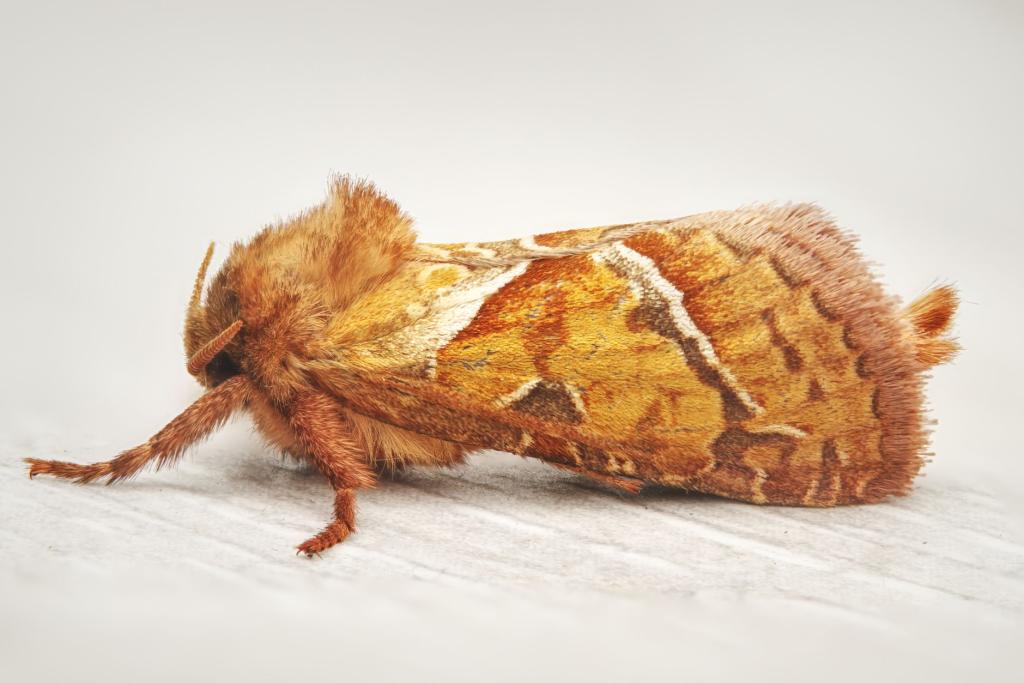
Moths are nocturnal, which helps them dodge birds, but it puts them on a collision course with bats. Bats hunt with echolocation, shouting ultrasonic calls into the dark and reading the echoes. Over millions of years, some moths evolved a countermeasure built directly into their wings: microscopic scales and structures that absorb sound waves and cut down acoustic reflections, working like an invisibility cloak against sonar, according to the University of Bristol.
The biology gets stranger in the lab numbers. In tests reported by Syfy Wire, researchers punched circular samples out of moth wings, mounted them on metal discs, and fired sound waves at the sandwich to compare the rebound against bare metal. The wing samples absorbed about eighty-seven percent of the incoming sound energy, and across a wide band of frequencies they performed roughly an order of magnitude better than the best sound-absorbing technologies engineers had managed to build. That range matters, because bats sweep through many frequencies while hunting, and it is the property that makes moth-wing soundproofing promising for human rooms.
Physicists would call this a metamaterial: individual scales, each under a millimetre long, resonate at particular frequencies depending on their shape and thickness, and their arrangement on the wing produces an effect none of them could manage alone. It is, in the words of Professor Marc Holderied of the university's School of Biological Sciences, "a resonator array shaped by evolution," as he explained in an interview with Syfy Wire.
Lead author Thomas Neil, working with Holderied, found the effect holds up even when wing sections sit in front of a hard, reflective surface like a wall, which is the case that actually matters for soundproofing. The absorption stayed near that level, stayed broadband, and worked from many incoming angles. The scale layer doing all this work is only about one fiftieth of the wavelength of the sound it absorbs, Neil reported, a thinness engineers had not matched with conventional materials, according to Interesting Engineering's write-up of the Royal Society study.
A related paper in the Proceedings of the National Academy of Sciences put the headline number even more starkly: the wing's scale layer is a metamaterial absorber one hundred eleven times thinner than the longest wavelength it swallows. Sound at this level of strangeness sits next to other recent acoustic oddities, like the first-ever observation of a quantum jump of sound.
From wing to wall
Attacus Acoustics is the attempt to turn that biology into moth-wing soundproofing panels, tiles, and linings. The research behind it was led by Professor Marc Holderied in the University of Bristol's School of Biological Sciences, and the spinout is now bringing the university's moth-inspired materials to market. The Business Desk reported the company's central claim: panels far slimmer than conventional alternatives, with absorption to match, which is the detail that makes the whole idea commercially interesting: moth-wing soundproofing stops being a renovation project and starts being something you can add almost anywhere.
The early markets the company is pointing at make sense once you think about weight. In aerospace and transport, every extra kilogram costs fuel, so a lighter acoustic material is valuable even before you consider the noise. In construction, thinness is the selling point, because nobody wants to lose half a room to insulation. Manufacturing plants, which have to meet workplace noise rules, get a material that can line equipment without eating floor space.
There is a consumer angle here too, even if the first customers are industrial. Headphone makers already sell silence as a feature, and the repairable-audio trend shows people want their gear to last; Sennheiser's latest flagship even lets owners fix it themselves. Passive moth-wing soundproofing would sit underneath all of that: the room itself doing the work that active noise cancellation currently has to fake with batteries and microphones.
What thinner walls could mean
A spinout announcement is the start of the hard part. Attacus Acoustics still has to scale manufacturing, prove the panels survive real buildings and real humidity, and hit a price that beats rock wool and foam. University spinouts fail at that jump all the time. But the underlying science behind moth-wing soundproofing is unusually solid, peer-reviewed across multiple papers, and the core advantage is not a marginal gain: it is a material that absorbs sound while barely taking up space, copied from an insect that has been perfecting the trick since before humans existed.
If it works at scale, the payoff lands exactly where city life hurts most. Rental bedrooms that stay quiet without a landlord's permission. Home studios that do not bleed into the neighbors' walls. Open-plan offices where one loud call does not become everyone's problem. Moths figured out how to disappear from sonar with a layer of scales thinner than a sheet of paper. The design is worth borrowing.
Comments 0
No comments yet. Be the first to share your thoughts!
Leave a comment
Share your thoughts. Your email will not be published.