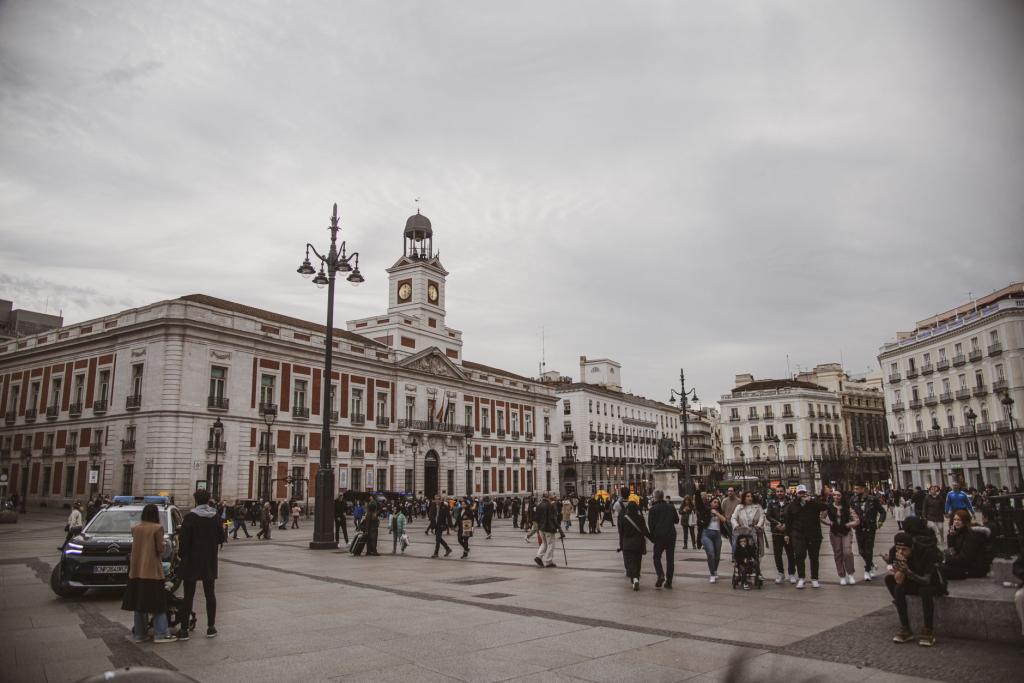
Tens of thousands of people marched through Madrid on Saturday, and many refused to go home afterward. What began as a tenants' march has become the Madrid housing protest now camped in Puerta del Sol, the city's historic central plaza, in an overnight encampment that carried into a second day of demonstrations on Sunday. They were there because of María del Carmen Abascal, an eighty-seven-year-old woman the city now knows simply as Maricarmen, who was evicted last Wednesday from the Retiro apartment where she had lived for most of her life. According to NPR, images of her removal traveled across Spain and turned a single eviction into the Madrid housing protest that has now taken over the plaza.
A home for seven decades, gone in a morning
The eviction itself was painful to watch. Abascal was carried from her apartment on a stretcher and placed in an ambulance while supporters who had tried to stop the eviction chanted her nickname. From her hospital bed afterward, she recorded a video message: "I haven't managed to defend my home, but I have fought so that others can learn to fight for what's theirs." Spanish media reported that her father first rented the apartment in nineteen fifty-six, and she stayed on as a tenant under rent controls after her parents died. When the building changed ownership in two thousand eighteen, she was offered the chance to buy the flat but could not afford it, according to the Madrid Tenants' Union. The investment fund Urbagestión later bought the unit and raised her monthly rent from five hundred euros to two thousand six hundred fifty euros, then lowered it to one thousand six hundred fifty euros, which she still could not afford on her pension, the union said. That rent hike is the grievance at the center of the Madrid housing protest.
Abascal's story landed because so many Spaniards recognize the arithmetic behind it. Incomes have not kept pace with rising housing costs, and analysts say tourism and immigration-driven population growth have squeezed the limited supply in the big cities, NPR reported. The Bank of Spain estimated the country was roughly half a million homes short last year, with Madrid, Barcelona and Valencia accounting for a large share of the gap. Spain also sits near the bottom of OECD countries for subsidized public rental housing, which makes up under two percent of the housing stock compared with an average of eight percent across the European Union. Figures like these are why the Madrid housing protest resonates far beyond Abascal's case. Critics call the investment firms that buy up homes and push rents up "vulture funds," and Abascal's case has become the emblem of that fight.
What Tuesday could change
The protesters want stronger tenant protections, measures to combat fraud, and a ban on evictions when no alternative housing is available. Those demands are the platform of the Madrid housing protest. Alicia del Río, a spokesperson for the Madrid Tenants' Union that organized the march, told journalists at the plaza on Sunday that "the wave of indignation and anger that has been unleashed is now unstoppable," and added that demonstrators would stay "until the government passes new laws, including indefinite rental contracts." One marcher, forty-three-year-old teacher Simón de la Riva, said that "Maricarmen has been, in a way, the last straw that sparked this social unrest." Twenty-seven-year-old actress Natalia Navarro, who camped out overnight, put it more bluntly: "The housing situation is unsustainable. We are all out on the street because we are fed up." Madrid is not the only protest flashpoint this month: Susan Sarandon and Hannah Einbinder were detained at an anti-Netanyahu UN protest, and South Africa's looming migrant documentation deadline has left families facing a similar fear of losing the place they live.
Prime Minister Pedro Sánchez can no longer ignore the Madrid housing protest. Speaking at a Socialist Party rally in Madrid, he addressed Abascal directly: "I have a message for you, Maricarmen: the government is working around the clock to bring a Royal Decree on housing next Tuesday. And I ask parliamentary groups to make one last effort to have it validated in the National Parliament for Maricarmen." Demócrata reported that the decree is being finalized against the clock after days of negotiations between the coalition partners. Abascal herself has been unimpressed; in an interview with Spain's state broadcaster RTVE the day before she was forcibly removed, she asked: "Does he not realize the quantity of evictions that there are daily? Does he not realize, or does he not want to realize?" Spain's Socialist-led government is expected to announce new measures at its weekly cabinet meeting on Tuesday.
For many in Madrid, the weekend's encampment recalled the indignados movement that began on May 15, 2011, when a different generation's Madrid housing protest occupied Puerta del Sol for twenty-eight straight days. That movement rose from a financial crisis, mass unemployment and austerity. This time the stakes have shifted, as political scientist Estefania Molina told Spanish television: in two thousand eleven, "people protested because they couldn't buy an apartment. Today, the protest is about not being able to rent a room in someone else's home." The full NPR account of how one eviction sparked this social unrest makes clear that whatever happens on Tuesday, the Madrid housing protest is not packing up on its own.
Comments 0
No comments yet. Be the first to share your thoughts!
Leave a comment
Share your thoughts. Your email will not be published.