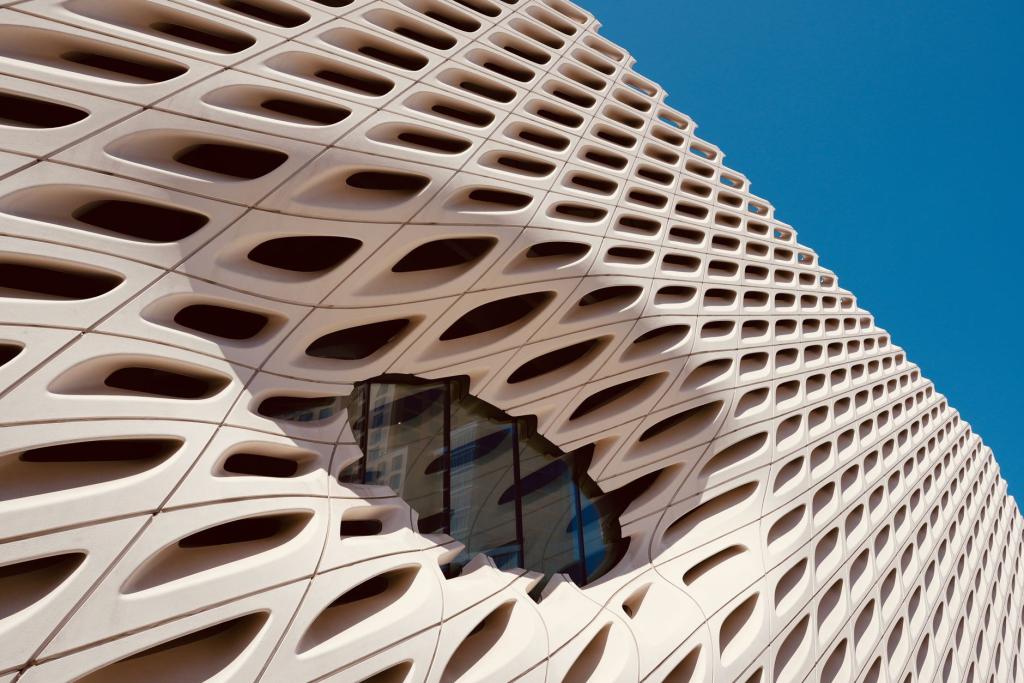
After more than a decade of planning, two rejected host cities and a budget that roughly doubled along the way, the Lucas Museum of Narrative Art finally opens to the public on Tuesday, September 22, in Los Angeles's Exposition Park. Founded by Star Wars creator George Lucas and his wife, Ariel Investments co-chief executive Mellody Hobson, the museum is the first major institution devoted entirely to narrative art: the visual storytelling found in cave drawings, comic books, illustrations, photographs and films.
The building itself is part of the draw. Architect Ma Yansong of the firm MAD designed the 300,000-square-foot structure as a smooth, curving form that visitors have already started calling a spaceship resting above the ground. It sits at the center of a new 13-acre public park and garden designed by landscape architect Mia Lehrer, green space built where a parking lot used to be. An opening preview for invited guests was held on September 2, and photographs from the event show the exterior essentially complete, with plantings already growing in the gardens.
A 13-year road to opening day
Lucas first announced the museum in 2013, and the route from announcement to opening was long enough to qualify as an epic in its own right. San Francisco and then Chicago each fell through as host cities before Los Angeles won the project. The budget grew from around 700 million dollars to a reported one billion. According to The Art Newspaper, the institution also changed designs and leaders, added and shed staff, and spent the years steadily amassing a collection of more than 40,000 works.
The past year brought its own turbulence. Director and chief executive Sandra Jackson-Dumont departed last February, after which Lucas took over content direction himself. In May, the museum laid off 14 percent of its full-time staff and eliminated seven part-time roles. The curatorial team now includes chief curator Pilar Tompkins Rivas, senior curator Ryan Linkof and Laela French, who heads the Lucas Archives. The board reads like a film credit roll: Guillermo del Toro and Steven Spielberg sit alongside former U.S. education secretary Arne Duncan.
What visitors will find inside
The museum holds 35 themed galleries, organized around ideas like love, family, community, play, work, sports, childhood and adventure rather than by period or medium. The collection's range is the whole point. Canonical names like Frida Kahlo, Norman Rockwell, John Singer Sargent and Robert Colescott share wall space with comic book and graphic novel artists including Jack Kirby, Alex Raymond, R. Crumb, Alison Bechdel and Chris Ware. The photography holdings include Gordon Parks, Dorothea Lange and Henri Cartier-Bresson. The Separate Cinema Archive documents the history of African American film, and the shelves of popular art run from Beatrix Potter to Alphonse Mucha to fantasy painter Frank Frazetta.
Star Wars fans will find the part of the museum that doubles as a pilgrimage site: the complete Lucas Archives from 1971 to 2012, with concept art, props, costumes and vehicle designs from the original six films. The inaugural exhibition, titled The History of Narrative Art: Heroes, Myths, the Sacred, fills the first floor with more than a thousand pieces, including 3-D-scanned reproductions of landmarks such as the Sistine Chapel ceiling, tracing how stories have shaped belief and community across centuries.
Why a museum for pop culture, and why now
The bet the Lucas Museum is making is a straightforward one: the line between fine art and popular art no longer holds, at least not for the generations raised on comics, animation and blockbuster cinema. Hobson has described the collection as "a museum of the people's art," saying the hope is that visitors will see their own lives reflected in the work on the walls. In a city where museum-going can feel like a members-only affair, the framing is deliberate. Other museums are making the same bet that pop culture belongs in the gallery: MOPOP's Styled by the Streets honors Black women in hip-hop fashion with more than thirty artifacts, from stage looks to the stylists behind them.
The practical details support that framing. Adult admission is listed at 25 dollars, according to CurationsLA. The research library, with books, archives and digital resources, is free to use. Two theaters run continuous film screenings, the rooftop Skywalker Grill serves visitors who want to linger, and the surrounding park and gardens are open to everyone at no cost. For South Los Angeles, a neighborhood that has not historically been a museum destination, that free public ground matters as much as what is inside the galleries.
Whether the museum can sustain its programming ambitions after a bruising construction history is an open question, and the staffing cuts this spring suggest the budget pressure is real. But on Tuesday, at least, the doors open on something American museums have never quite tried: a single building that treats a Kirby splash page and a Kahlo self-portrait as chapters of the same story. According to The Art Newspaper, the project changed cities twice and leaders along the way, yet the premise survived intact. Now visitors get to decide if it works.
Comments 0
No comments yet. Be the first to share your thoughts!
Leave a comment
Share your thoughts. Your email will not be published.