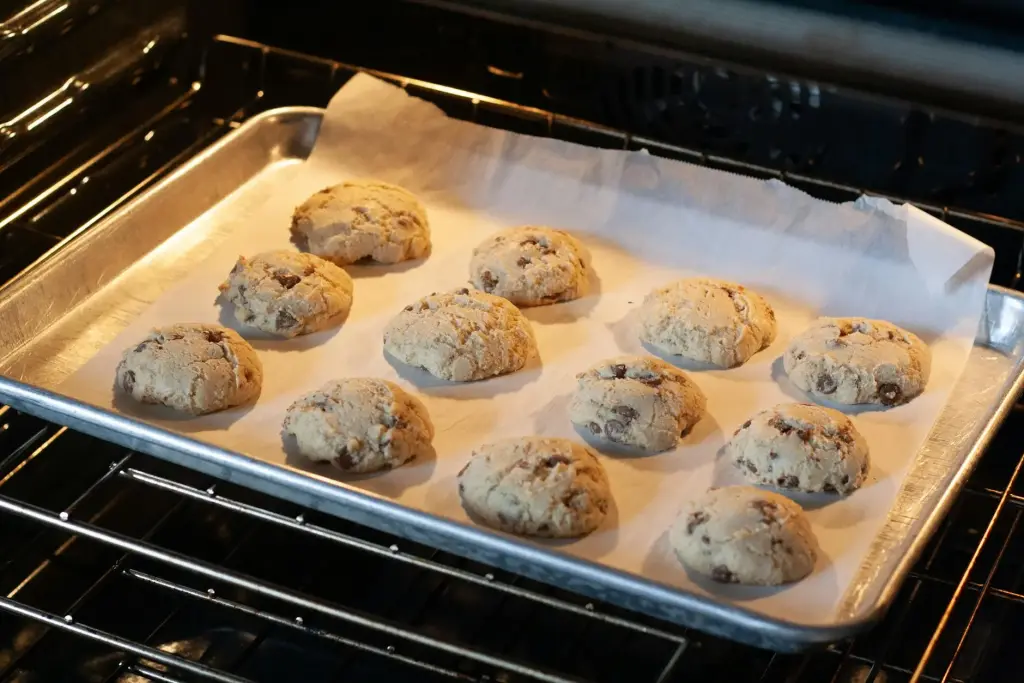
Chocolate chip cookies are simple enough to encourage shortcuts and sensitive enough to punish them. A scoop that is too large, a butter balance that is off, or a tray left in the oven just a minute too long can change the result from chewy to dry in a hurry. Cookie basics are really about deciding what texture you want and then baking toward that texture on purpose.
According to King Arthur Baking, its classic cookie guidance shows how butter, sugar balance and careful bake timing shape whether a cookie stays chewy, crisp or somewhere in between. That is why good cookies are less about secret ingredients and more about consistency in dough, portioning and bake timing.
Dough balance shapes the final texture
Brown sugar usually pushes cookies toward chew while white sugar supports spread and crisp edges. Butter adds flavor and richness, but it also changes how quickly the dough relaxes in the oven. Cookie basics therefore begin long before the tray is loaded. The ingredient balance determines whether the cookie wants to be thick, thin, chewy or crisp.
Flour matters too. Too little and the cookies spread into thin sheets; too much and they bake up dense and dull. Measuring carefully is one of the least glamorous cookie habits and one of the most important.
Portion size and spacing should stay consistent
Cookies bake evenly when scoops are similar in size and spaced far enough apart to spread without merging. Random scoop sizes create a tray where some cookies are dark on the edges while others remain pale in the center. Cookie basics get easier when the tray behaves predictably.
If the dough seems very soft, a short chill can help control spread. That does not mean every dough must be chilled for hours, but warm dough tends to flatten faster. A short rest can make the tray easier to manage and the shape easier to repeat.
Pull the tray before the center looks fully finished
A cookie continues setting on the hot tray after it leaves the oven, which is why the best time to pull it usually arrives before the center looks fully firm. The edges should be set and lightly colored while the middle still looks soft. Waiting until everything looks fully dry often guarantees a harder cookie later.
This is especially important for home ovens that run hot. Cookie basics rely on watching the tray itself rather than trusting the clock alone. Visual cues almost always matter more than the last minute on the timer.
Cool enough to set, then store with texture in mind
Cookies need a short rest on the pan before they move to a rack. That pause lets the structure finish setting so the bottoms do not tear. Once cooled, storage affects texture almost as much as the bake. Covered cookies stay softer; open air dries them out.
Cookie basics stay reliable when the whole process feels controlled: measured dough, even scoops, early pull and sensible storage. That is how a tray becomes repeatable rather than lucky.
The goal is not perfection on the first tray. It is understanding which choices create the texture you actually want, then repeating them on purpose.
Portioning and cooling decide whether cookies stay chewy
Even good dough can bake unevenly if the scoops vary too much in size. Uniform portions help the edges and centers finish at the same pace, which matters when the goal is a soft middle and set outer ring. Cooling on the pan for a short time also matters because the cookies continue to firm after they leave the oven.
Storage changes the result too. Keeping cookies airtight once fully cool helps preserve texture, while warm cookies sealed too early create trapped steam that softens the crust. If the goal is a bakery-style chew, the bake, rest and storage steps all need to support that texture instead of treating the tray as finished the second it leaves the oven.
Comments 0
No comments yet. Be the first to share your thoughts!
Leave a comment
Share your thoughts. Your email will not be published.