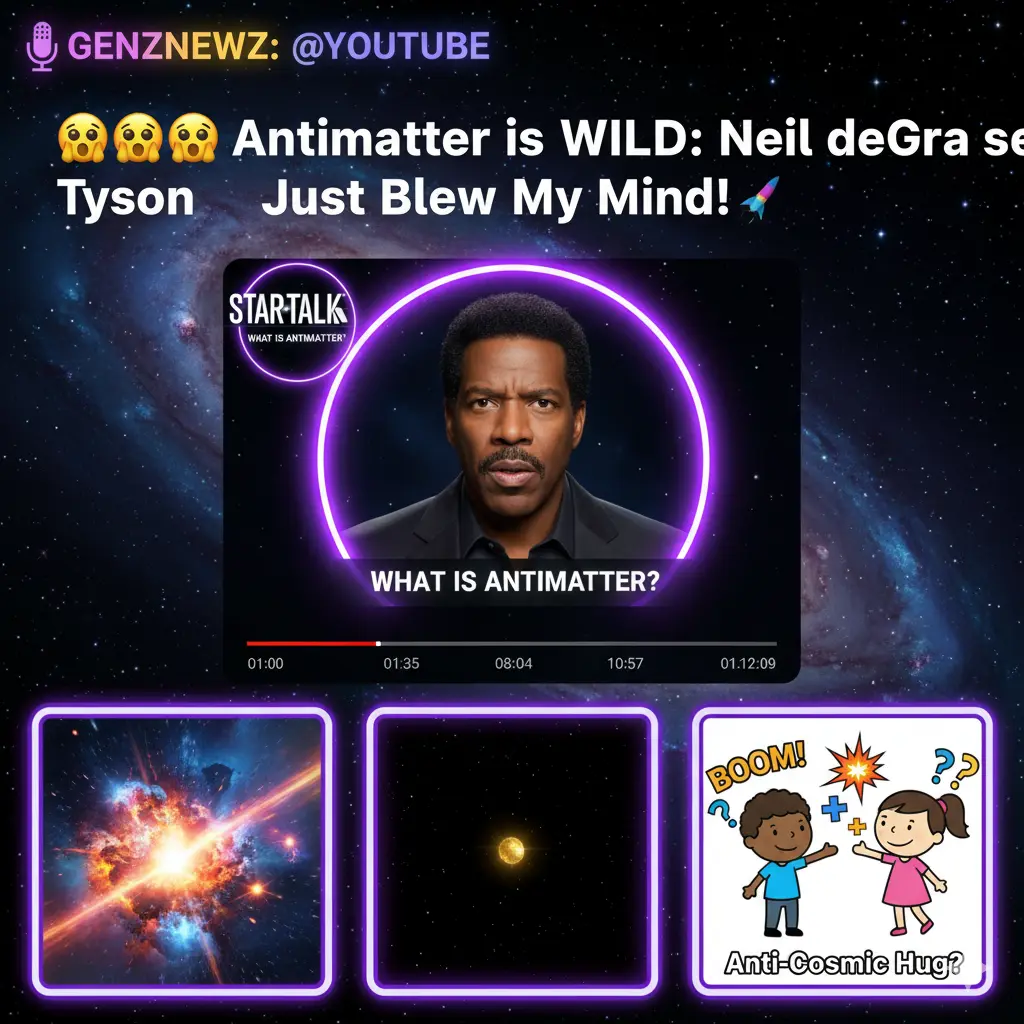
The Opposite of Everything?! 🤯 Neil deGrasse Tyson just dropped some serious knowledge about antimatter that will fundamentally change how you understand the universe. Let's break down this mind-bending cosmic concept that's literally the opposite of everything we know.
What Is Antimatter, Really?
So, you know how electrons are negative? Well, antimatter particles are their total opposites! Neil called the anti-electron a "positron" [01:35] – keeping it positive, I guess? Every particle of matter has an antimatter counterpart with opposite properties. Anti-protons are negative while regular protons are positive. Anti-neutrons exist too, with subtle quantum differences from their matter twins.
But here's the kicker: when matter and antimatter meet, they annihilate each other and turn into pure energy! [01:42] Like, poof, gone. This isn't science fiction – it's hard physics that happens in particle accelerators daily. The energy released is enormous because of Einstein's famous E=mc² equation. That tiny "c²" (speed of light squared) means even small amounts of mass create massive energy outputs.
The Mind-Blowing Math
Neil broke down exactly why this matters. Einstein's E=mc² shows how mass converts to energy [02:14]. When a gram of matter meets a gram of antimatter, they completely annihilate, releasing energy equivalent to about 43 kilotons of TNT – roughly three times the Hiroshima atomic bomb. From just two grams of stuff.
This efficiency makes antimatter the most energy-dense substance known. If we could harness it (spoiler: we can't really, yet), a gram of antimatter fuel could power a spacecraft to Mars and back. It's the ultimate energy source – and the ultimate weapon.
The Universe Shouldn't Even EXIST?! 😳
This is where it gets even crazier. Neil explained that in the early universe, there was this hot, chaotic soup of matter and antimatter, constantly being created and then annihilating each other back into energy [08:04]. The Big Bang should have produced equal amounts of both.
If everything played by the rules, our universe should just be, like, a giant light show with no stars, no planets, and definitely no us [09:23]. All matter and antimatter should have cancelled out, leaving nothing but radiation. But apparently, out of every billion particles created, there was one extra particle of matter. That tiny imbalance – 0.0000001% – is literally the only reason anything exists at all.
Why the Imbalance? Nobody Knows!
This is one of physics' biggest unsolved mysteries. Scientists have theories:
- Maybe matter and antimatter behave slightly differently (violate CP symmetry)
- Perhaps unknown particles created the imbalance
- Could be related to dark matter interactions
- Maybe the universe started with matter already dominant
CERN's Large Hadron Collider and other facilities are smashing particles together trying to find answers. Every experiment brings us closer to understanding why we exist.
Real-World Applications of Antimatter
Antimatter isn't just theoretical – it's used right now:
Medical Imaging (PET Scans)
Positron Emission Tomography uses positrons (anti-electrons) to create 3D images of your body. When positrons meet electrons in your tissues, they annihilate, producing detectable radiation. This technology saves lives by detecting cancers and brain disorders.
Scientific Research
Particle accelerators create antimatter to study fundamental physics. By colliding matter and antimatter at high energies, scientists recreate conditions similar to the Big Bang, learning how the universe formed.
Future Propulsion (Maybe)
NASA and other space agencies have theorized about antimatter rockets. The energy density could enable interstellar travel. The challenges? Creating and storing antimatter safely. We're talking decades, maybe centuries, before this becomes reality.
Making Antimatter: Really Hard, Really Expensive
Here's the wild part: creating antimatter requires enormous energy input. CERN can produce about 10 nanograms of antiprotons per year. At that rate, making a gram would take longer than the universe has existed. And it would cost about 2.5 trillion per gram.
Storage is equally challenging. Antimatter must be kept in magnetic traps, suspended in perfect vacuum, away from any regular matter. Touch the container walls? Annihilation. Power failure? Annihilation. It's like trying to hold water with your hands.
Antimatter in Pop Culture (Usually Wrong)
Movies love antimatter. "Angels \u0026amp; Demons" featured an antimatter bomb threatening Vatican City. "Star Trek" uses antimatter for warp drives. The reality? Way more complicated and less explosive than Hollywood suggests.
Real antimatter explosions wouldn't look like nuclear blasts. They'd be pure energy release – intense gamma radiation and particle showers. Not visually dramatic, but absolutely lethal.
The Existential Takeaway
Neil's explanation reveals something profound: our existence is statistically improbable. That tiny matter-antimatter asymmetry – the reason anything exists – could have easily not happened. We're living in a universe that "shouldn't" exist according to pure symmetry.
Every atom in your body exists because of that billion-to-one imbalance from 13.8 billion years ago. You're literally made of cosmic luck. Pretty humbling, right?
Want to Learn More?
Neil deGrasse Tyson's full explanation covers way more ground – quantum field theory, baryon asymmetry, and the ongoing search for answers. Check out his videos on YouTube or pick up his books for the complete cosmic perspective.
And next time someone says "the universe is perfectly balanced," you can hit them with this: actually, it's slightly unbalanced, and that's literally the only reason we're here to talk about it. 🤯🚀🌌
Comments 0
No comments yet. Be the first to share your thoughts!
Leave a comment
Share your thoughts. Your email will not be published.