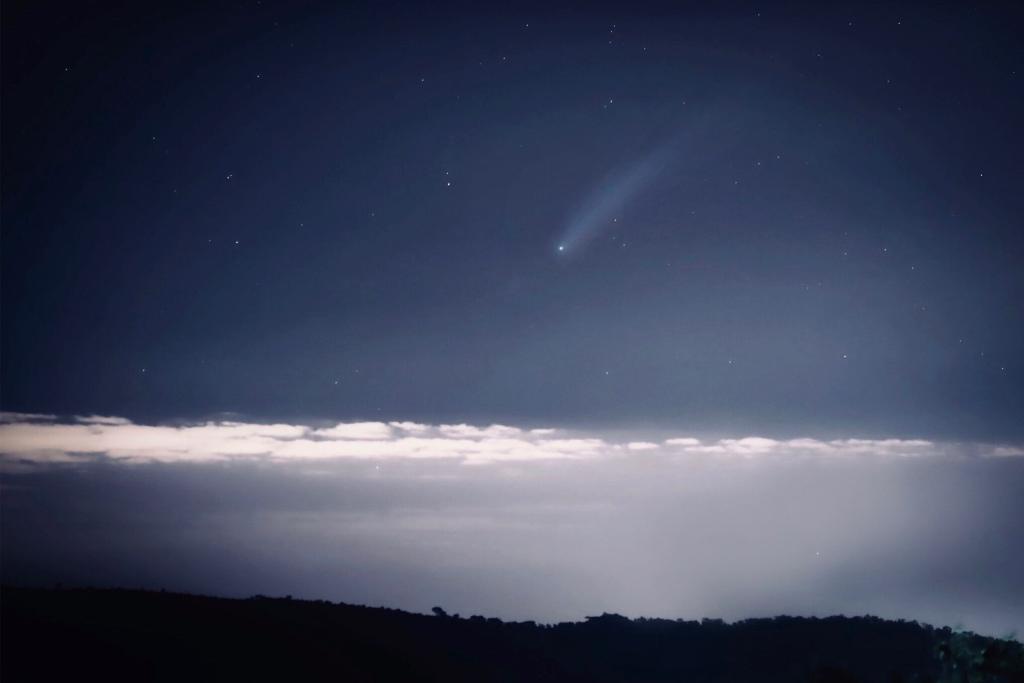
Comet Lemmon is about to make its closest approach to Earth, and the timing could hardly be better for skywatchers. Later this month, the rare green-glowing visitor sweeps to its nearest point, passing roughly 89 million kilometers from Earth on the same night the Orionid meteor shower reaches its peak. That pairing of a centuries-old wanderer with around twenty meteors an hour from debris left behind by Halley's Comet turns one autumn evening into a genuine double feature. As reported by National Geographic, conditions are shaping up well for anyone who finds a dark sky.
The comet, officially catalogued as C/2025 A6 (Lemmon), was first spotted in January 2025 by the Mount Lemmon Survey in Arizona, according to Space.com. It has brightened steadily ever since while racing toward the inner solar system, and it keeps falling sunward toward perihelion, the closest point of its orbit to the Sun, in early November. SpaceWeekly reports that the object rides a highly elongated retrograde orbit so stretched that one full lap takes about fourteen hundred years. This month's appearance is a once-in-a-lifetime event for everyone watching.
Why it glows green
Comet Lemmon's signature color comes from chemistry. Spectroscopic measurements show the coma, the cloud of gas and dust wrapped around the icy core, shines green because diatomic carbon fluoresces under harsh solar ultraviolet light, reports SpaceWeekly. Early telescope images also caught a thin, straight ion tail pointing directly away from the Sun, the classic comet silhouette. SpaceWeekly notes that around the close approach the comet will sit near the star Rho Boötis, shifting westward from night to night as it dives toward perihelion. As sunlight heats the nucleus through October, sublimation accelerates and the comet keeps getting brighter from night to night.
That unpredictability is part of the fun for comet watchers, and it is why astronomers hedge their forecasts. Space.com notes that forecasting a comet's appearance is notoriously tricky, since brightness, color and tail shape depend on the orbit, the angle relative to Earth and the Sun, and the makeup of the icy nucleus. Comet Lemmon has been an unusually active visitor so far, with its tail structure visibly shifting from one night to the next in long-exposure photographs. Astronomers are hopeful rather than certain that the brightening trend continues into the close approach.
Comet Lemmon is a time capsule. The icy nucleus formed in the outer solar system's deep freeze and has spent most of its long lap in the cold dark, vaporizing only now as the Sun's heat reaches it. Every wisp of gas in the coma is material that last saw warmth centuries before the printing press existed. As National Geographic reports, the comet's dust is like a trail of breadcrumbs leading back to how the solar system itself came to be.
How to see it
Getting away from city lights matters more than any equipment. From truly dark rural skies the comet may be glimpsed with the unaided eye, and it becomes much easier through binoculars or a camera on a tripod, according to National Geographic's skywatching guide. Look low on the western horizon just after sunset, toward Scorpius and Libra, and give your eyes a good half hour to adjust. Binoculars reveal the coma, the fuzzy glow around the core, that the naked eye may register only as a soft smudge.
Comet Lemmon's viewing window runs from mid-October into early November, with peak brightness expected around the close pass on October 21. Moonlight is the enemy of faint objects, so a new moon early in the month helps: the darkest skies of October fall right inside the comet's prime viewing period. Check moonrise and moonset for your location with a stargazing app or a skywatching calendar, and plan around it. If you can manage a second outing, the Orionids are worth it on their own. Head out in the early morning hours, after the Moon sets, and watch for quick meteors radiating from the direction of Orion.
Comments 0
No comments yet. Be the first to share your thoughts!
Leave a comment
Share your thoughts. Your email will not be published.