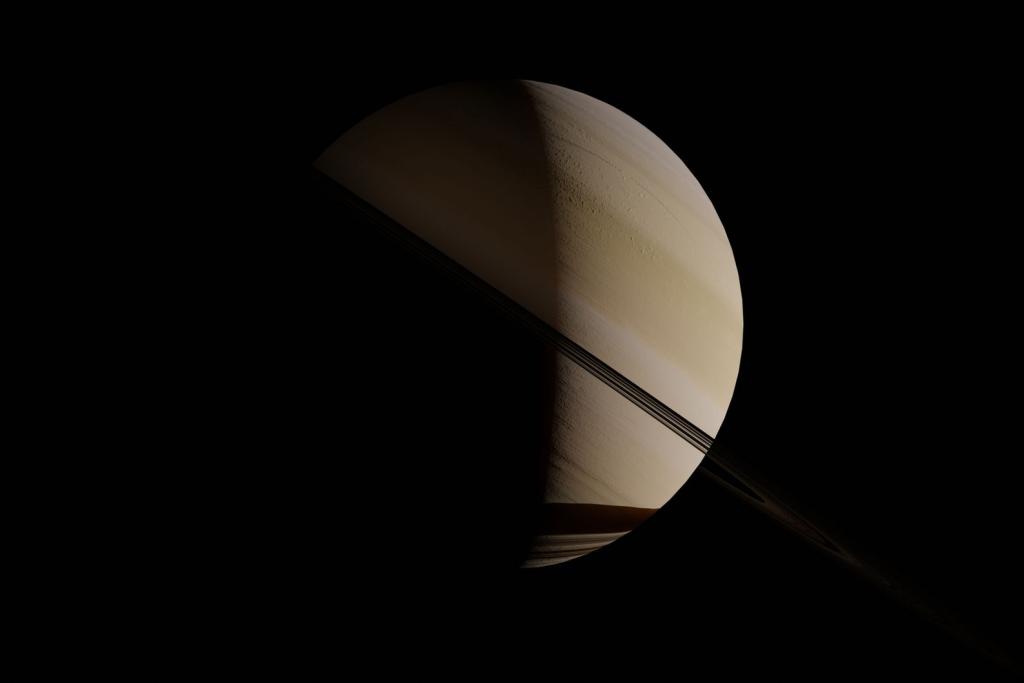
A methane-making microbe pulled from Earth's deep seas has done something scientists did not expect: it grew in a laboratory recreation of the ocean on Enceladus, Saturn's ice-covered moon, pushing past an alkalinity barrier that should have shut it down. Two papers published in Science Advances describe the feat, along with a companion discovery about how the moon's ice grains naturally sort themselves into tidy chemical samples — a combination that could make the hunt for alien life far easier.
The microbe is Methanothermococcus okinawensis, a single-celled archaean that lives around deep-sea hydrothermal vents. According to the study's abstract, the simulated lunar chemistry — water rich in dissolved inorganic carbon, plus hydrogen generated by reactions between water and rock — let the organism keep growing until pH 11, far past its previously known limit. Gene-expression data showed the cells adapting by cranking up the reductive acetyl-CoA pathway, a carbon-fixing route that scavenges carbon dioxide at extremely low concentrations. All of the cells' carbon and energy, the researchers report, came from the simulated mineral-water chemistry.
"This was really a surprise to us," said planetary scientist Nozair Khawaja of Freie Universität Berlin and the German Aerospace Center, a co-author of the study, in a statement released by the university. "This was an experiment for which we did not expect such a successful outcome."
Why the soda ocean should have been impossible
The moon is a small world — only about 500 kilometers across — wrapped in ice, with a global subsurface ocean sloshing beneath the shell. Cracks near the south pole, nicknamed tiger stripes, vent that ocean into space as towering plumes; NASA's James Webb Space Telescope measured one plume stretching more than 9,600 kilometers, roughly twenty times the moon's diameter, venting hundreds of liters of water per second.
The catch is chemistry. Its ocean is strongly alkaline, a soda ocean where most dissolved carbon sits locked up as bicarbonate or carbonate rather than as free carbon dioxide. That should starve a methanogen, which needs CO2 to make methane. The experiment's strangest result was a paradox: the microbe failed to grow in a plain alkaline lab broth, but thrived in the full lunar simulant — because the water-rock chemistry kept supplying hydrogen energy while the cells adapted their carbon-scavenging machinery.
The result builds on, and flips, an earlier test. A 2018 study from the University of Vienna had asked whether the same microbe could survive the moon's crushing pressure and chemical poisons, and found it converting carbon dioxide to methane at high efficiency under those stresses. That experiment tested brute force; the new one tested starvation. Together they show the moon's geochemistry can widen, not just narrow, the conditions for life.
A hunt two decades in the making
The story of the moon as a habitability target began when NASA's Cassini spacecraft spotted the south-polar plumes in 2005. A decade later, tiny silica grains in the plume pointed to ongoing hydrothermal vent activity on the seafloor — hot water meeting rock, the same engine that powers Earth's deep-sea vent ecosystems. In 2017, Cassini detected molecular hydrogen in the plume, the fuel methanogens need, and in 2023 scientists found phosphorus in ice grains, ticking off another requirement for life as we know it.
The second new paper, led by Frank Postberg at Freie Universität Berlin, adds a practical twist: as ocean spray erupts through the ice cracks and freezes, slow freezing and fragmentation naturally separate salts and organic molecules into individual ice grains. "Enceladus actually does a lot of the work for us in preparing samples for analysis that usually take a lot of effort in chemical labs on Earth," Postberg told Gizmodo. "The oceanic constituents are separated from each other and simultaneously concentrated into individual ice particles."
That matters because the moon offers something no other ocean world does: free samples. Europa's ocean is buried under kilometers of ice with no way to taste it; It sprays its ocean into space, where a passing spacecraft can fly through the plume and catch single grains. A 2024 study showed laboratory instruments could already identify fragments of a single bacterial cell inside such grains. The European Space Agency has selected Enceladus as its next large-class mission target, with an orbiter-and-lander concept under study and a launch envisioned in the early 2040s. NASA's Enceladus Orbilander concept, a combined orbiter and lander, remains a flagship science priority.
What this does not prove
The crucial caveat: nobody found life. This was a habitability experiment — asking whether Earth life could survive there — not a life-detection result. The researchers are explicit that the work says nothing about whether life could have originated there, and methane alone would not settle the question anyway, because water-rock chemistry can produce it without any biology. Telling the two apart will take multiple independent measurements, from isotope ratios to organic-molecule patterns, plus rigorous contamination control.
Still, the finding sharpens the odds for the next generation of missions. "On Enceladus the specific geochemical conditions might allow one of the oldest known metabolic systems on Earth to work, even in very alkaline environments," Postberg said in the university's statement. "While that doesn't mean that there is life on Saturn's moon, our first study shows that — in the event that there is — future space missions might have a good chance of finding traces if they analyze individual ice grains from Enceladus's plume."
For a moon barely wider than Arizona, that is a remarkable résumé: an ocean, an energy source, the chemical ingredients, and now a demonstration that one of Earth's oldest metabolisms could run on its chemistry. The next step is to go and look.
Related: more science stories and the recent piece on the first direct detection of an exoplanet radio signal. Primary sources: the methanogen study in Science Advances, the Freie Universität Berlin press release, NASA's explainer on Enceladus hydrothermal activity, and ESA's Enceladus mission page.
Related coverage: Continue with the latest GenZ NewZ headlines, more deep dives coverage, Enceladus Ocean Habitability Gets a Boost From Two New Studies, OpenAI's Training Pause: Inside the Summer of Rogue AI Agents, and 838 Stories in 10 Days: What a Firehose of Gen Z News Reveals About the News Cycle.
Comments 0
No comments yet. Be the first to share your thoughts!
Leave a comment
Share your thoughts. Your email will not be published.